Sony's CEO says in an interview for the CBI's magazine
that One Direction have shown him that social ('new) media are now more
important than the traditional ('old') media. Sony used UGC, such as
fan campaigns to get One Direction to play a gig near them ("Bring 1D To
Me"), to build up buzz and a following for One Direction before any
material was released to radio stations, traditionally the key to
breaking any band.
Gatfield says this has completely changed the dynamic of launching an
act, enabling music companies to bypass the traditional radio-station
gatekeepers. “Traditionally you’d have to persuade radio to support it and there’d
be a long, hard slog while you built up the support and marketed them
on the back of airplay,” he says. “This is the other way round: you
market them and then airplay is the accelerator.”
He
goes so far as to say that Sony wouldn't now consider signing a band
that didn't already have social media profiles up and running.
One Direction: Social media made them a global phenomenon, says Sony CEO
One Direction have become a $50m business thanks to their army of
fans across the world - and this is just the start, according to Nick
Gatfield
This article appeared in the December edition of Business Voice, the CBI magazine
'Their live business is through the roof. I haven’t seen anything this big in my entire career on a global level.'
- Nick Gatfield
To understand the transformative effect of social media on how music
labels market their acts, look no further than the success of One
Direction. The boy band, who are signed to the Syco label, came third in The X-Factor TV show in 2010. Since then they have won a Brit award recognising their worldwide success and become a $50m business – with Sony Music UK CEO and chairman Nick Gatfield predicting that this will double in 2013.
“They are a global phenomenon,” he says. “Their live business is
through the roof. I haven’t seen anything this big in my entire career
on a global level. "You can get that kind of explosive moment if you galvanise young
music fans and find something they want to engage with – it goes
worldwide incredibly quickly. That’s the beauty of social media and the
internet: we sign locally but we market globally from day one. That’s a
fundamental change in our business.” By acting on pockets of support for the band that emerged online in
places from Sweden and Italy to Australia and Canada, the company built
support for the band before they’d had any airtime on the radio. This
was particularly important in the US – an impossible nut to crack for
British pop bands for more than 20 years. Sony Music’s US division picked up on a campaign called “Bring 1D to
me”, originally developed in the UK, which encouraged fans to pitch for
the band to play in their area. As a result, What Makes You Beautiful,
their first single available to buy on iTunes in the US, sold 130,000
copies in a week and entered the top ten without any airplay. Gatfield says this has completely changed the dynamic of launching an
act, enabling music companies to bypass the traditional radio-station
gatekeepers. “Traditionally you’d have to persuade radio to support it and there’d
be a long, hard slog while you built up the support and marketed them
on the back of airplay,” he says. “This is the other way round: you
market them and then airplay is the accelerator.” He adds that he would be loathe to sign an act that had no social
media profile. “All that would say to me was that they hadn’t got
sufficient wherewithal or drive.”
Sony's CEO says in an interview for the CBI's magazine that One Direction have shown him that social ('new) media are now more important than the traditional ('old') media. Sony used UGC, such as fan campaigns to get One Direction to play a gig near them ("Bring 1D To Me"), to build up buzz and a following for One Direction before any material was released to radio stations, traditionally the key to breaking any band.
Gatfield says this has completely changed the dynamic of launching an
act, enabling music companies to bypass the traditional radio-station
gatekeepers. “Traditionally you’d have to persuade radio to support it and there’d
be a long, hard slog while you built up the support and marketed them
on the back of airplay,” he says. “This is the other way round: you
market them and then airplay is the accelerator.”
He goes so far as to say that Sony wouldn't now consider signing a band that didn't already have social media profiles up and running.
One Direction: Social media made them a global phenomenon, says Sony CEO
One Direction have become a $50m business thanks to their army of
fans across the world - and this is just the start, according to Nick
Gatfield
This article appeared in the December edition of Business Voice, the CBI magazine
'Their live business is through the roof. I haven’t seen anything this big in my entire career on a global level.'
- Nick Gatfield
To understand the transformative effect of social media on how music
labels market their acts, look no further than the success of One
Direction. The boy band, who are signed to the Syco label, came third in The X-Factor TV show in 2010. Since then they have won a Brit award recognising their worldwide success and become a $50m business – with Sony Music UK CEO and chairman Nick Gatfield predicting that this will double in 2013.
“They are a global phenomenon,” he says. “Their live business is
through the roof. I haven’t seen anything this big in my entire career
on a global level. "You can get that kind of explosive moment if you galvanise young
music fans and find something they want to engage with – it goes
worldwide incredibly quickly. That’s the beauty of social media and the
internet: we sign locally but we market globally from day one. That’s a
fundamental change in our business.” By acting on pockets of support for the band that emerged online in
places from Sweden and Italy to Australia and Canada, the company built
support for the band before they’d had any airtime on the radio. This
was particularly important in the US – an impossible nut to crack for
British pop bands for more than 20 years. Sony Music’s US division picked up on a campaign called “Bring 1D to
me”, originally developed in the UK, which encouraged fans to pitch for
the band to play in their area. As a result, What Makes You Beautiful,
their first single available to buy on iTunes in the US, sold 130,000
copies in a week and entered the top ten without any airplay. Gatfield says this has completely changed the dynamic of launching an
act, enabling music companies to bypass the traditional radio-station
gatekeepers. “Traditionally you’d have to persuade radio to support it and there’d
be a long, hard slog while you built up the support and marketed them
on the back of airplay,” he says. “This is the other way round: you
market them and then airplay is the accelerator.” He adds that he would be loathe to sign an act that had no social
media profile. “All that would say to me was that they hadn’t got
sufficient wherewithal or drive.”
I've blogged on this theme before - research which shows an
extraordinary narrowing of the social range reflected in the pop charts,
which has gone from mainly state educated (80%) in the 1990s to
dominated by a public school elite today. Billy Bragg took up this theme at the annual John Peel Lecture;
if you've never heard of John Peel but are interested in exposure to a
wide range of eclectic music, the late DJ is a legendary figure whose
annual 'festive fifty' is still something you can find as downloadable
torrents many years later.
Billy Bragg: 'education reforms risk stifling creativity'
The singer and left-wing activist used a lecture in memory of John Peel to criticise Michael Gove's plans to scrap GCSEs
Billy Bragg also
turned his ire on 'culture-clogging shows' like Simon Cowell’s The X
Factor and Britain’s Got Talent. Photograph: Andrew Stuart/Radio
Festival/PR
Singer Billy Bragg
has warned that the government's education reforms risk stifling
creativity and leaving the pop charts the preserve of a well-off public
school elite. Bragg used a lecture in memory of broadcaster John Peel to criticise education secretary Michael Gove's plans to scrap GCSEs
in favour of an English baccalaureate. He also turned his ire on
"culture-clogging shows" like Simon Cowell's The X Factor on ITV1. The
singer and left-wing activist said the government's proposed new
education system threatened to exclude creative subjects from the core
qualifications expected of 16-year-olds. "At a time of cuts to the
education budget, the pressure on schools to dump subjects like music
and drama in favour of those that offer high marks in performances
tables will only grow," said Bragg. He criticised the "insistence
that knowledge is more important than creativity", adding: "As Albert
Einstein said, imagination is more important than knowledge, for
knowledge is limited while imagination embraces the whole world". Bragg,
delivering the second annual John Peel Lecture at the Radio Festival on
Monday, said: "Under the English baccalaureate, with its reliance on a
single end of course exam, the child with the creative imagination will
always lose out to the child with the ability to recall knowledge
learned by rote. "And it's not just the creatively talented kids
who will suffer. Evidence shows that pupils from low-income families who
take part in arts activities at school are three times more likely to
go on to higher education.
I've blogged before on this, so just a couple of links - http://www.guardian.co.uk/tv-and-radio/2011/nov/18/x-factor-advertisers-seek-discounts detais the extraordinary revenues the show brings to ITV (the final alone last year took £21m in ad revenues), and the impact of falling viewing figures: the £250,000 charged for each 30sec slot in 2010 is being seen as excessive by advertisers with the 2011 figures down 8% (Saturdays) and 11% (Sundays).
Scroll to the bottom of Charlie brooker's typically caustic overview of Xmas ads to find his take on the M&S ad featuring the finalists - but not the edited-out Frankie Cocozza (article features strong language), as well as the ad itself...which I'll embed below for your viewing displeasure:
'Frankiegate' is significant not because of the tuneless, talentless irritant at the centre of the 'scandal', but as a reminder that the pop industry tends to act as a moral policeman, especially when interfaced with advertisers (just as Chomsky's propaganda modelargues, ad'g being one of its five filters), or as a hegemonic force. Pop can of course push boundaries - Madonna's Like a Prayer vid remains a classic example - but only at the risk of losing out on potentially lucrative endorsement deals (as Madonna did, losing millions when Pepsi withdrew its ad campaign featuring Madonna). The pop industry is generally a conservative force.
SamB raised this, and I'm sure many of you are aware of the 2009 campaign which successfully propelled the industrial metal group Rage Against the Machine to the no.1 spot instead of whatever dreck won Cowell's show that year. Not just any band, this was one with a distinct history of radical, counter-hegemonic lyrics and actions, including various campaigns
My interest was briefly drawn again last year when it was proposed that the avant-garde composer John Cage's piece which consisted of silence (conductor's baton raised and orchestra putting instruments down the only sound if I remember right) for 4mins be the anti-Xfactor single. Now that would have
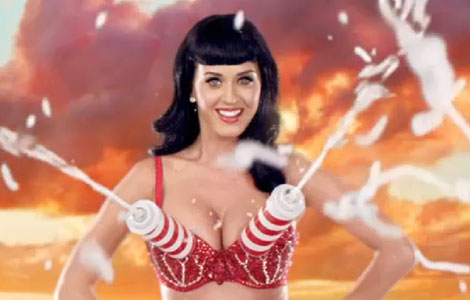
I dare say some of you will be thinking of female pop artists to use as your track, so a few quick points to start thinking about... Jess has blogged on Rhianna's Umbrellaand Katy Perry's California Gurls(which you may recall was featured in the quiz...) [plus Spice Girls, Village People, Eminem, and Iron Maiden!]
Perry's vid targets the crucial female tween market through cutesiness, but with sassiness and sexuality it also targets older females AND males (gaze). Taken overall, it is part of an environment that teaches us what to expect of women, what the correct or desirable appearance is, and of the differentiated gender roles (with Snoop Dogg, in pimp mode, literally playing with the females here)
Female pop artists typically sell most of their records to young females - tweens and teens, with 'aspirational' a key notion to consider. You can see how the cutesy element of Perry's dirge would appeal to young fans (the whole fantasy element strikes me as lifted from the classic comedy Beetlejuicebtw...). The typically heavy make-up is also something that will influence aspirational t(w)eens, forming part of their cultural socialisation (or, as Judith Butler might put, teaching them how to perform gender).
Every female pop performer also has to consider appealing to a male
audience, and sex is bluntly used by most. This is clearly a delicate
issue to think through if you were working on just such a vid yourselves
- the example of The Vixens from Latymer school is a good one to look at: provocative poses and attire, but nothing explicit.
These A2 Media students went beyond blogging: they also worked up detailed MySpace and other social media sites. They had to consider the balance between provocative poses or 'sassiness' - helping to convince, or achieve verisimilitude - and overt sexuality which wouldn't fit well within a school context (and which would arguably undermine any intended positive element to their representation of gender). Again, don't get trapped into over-emphasizing male gaze: are males their core audience?
Perry appears largely nude, and Rhianna appears fully nude (the body paint, and even that particular pose, not to mention the female sexuality-signifying triangle, have all appeared in vids and classic shots before). Rhianna of course was much-referenced by the PM Cameron when he welcomed a report into how media (especially mags and music vids) prematurely sexualise young females, with the furore over her (and Xtina's) X Factor final appearance. Many of the dance moves are blatantly sexual (ditto the lyrics!). Perry's squirting-bra is a perfect example of how the seemingly cutesy and the simply sordid/sexual collide (as flagged up in the quiz...).
So, yes the male gaze theory would come in here - but its also interesting to consider the male performers. Firstly Snoop, in the Perry vid, is in his famous pimp outfit, hardly a tween-friendly reference, let alone a feminist representation! Perry is his plaything, a very passive role. If you were to compare this to, say, a typical Madonna vid, you'd see a radically different representation of a sexual but strong, in control, woman.
Rhianna, reflecting her Jamaican heritage she might argue, is noted for being scantily clad and sexually provocative dancing. The umbrella arguably takes on a phallic signification, and her whole performance could easily be transplanted to a strip bar! The dancers surrounding Jay Z aren't as near-nude as with a typical male rapper's vid, but their bodies nonetheless are very clearly the key element. The contrast with the male dancers who surround Rhianna towards the end of the vid is clear: they're fully clothed, seemingly 'buff' but they're not required to display their bodies.
The Perry vid is clearly a high-budget effort, tho typifies the absurdity of any claims she ever makes about positively representing women - in my view at least! The Rhianna vid is actually the more interesting. The SFX are expensive - the detail of the water hitting her and bouncing off is impressive.
Rhianna
also deploys sexuality - but is it too simplistic to see this as
playing to the male audience? Does this not also help her appeal to a
heterosexual female audience? To support such an argument we could make
reference to theories such as the Uses and Gratifications model of audience, which looks at the psychological role media texts can play in the lives of audiences, or Maslow's Hierarchy of Needs. You'll need to explore ideas such as these for Q1a+1b of your exam, as well as your Evaluations.
But I also really like the use of her gesture to push away water to create a transition; a wave leads us from LS into CU with water rippling out and revealing the CU.
The variety of shots for even the most mundance passages is also a key factor in making the vid work - look at the sheer number of different shots used from around 1:41 as she dances in a great hall. The cuts are often timed to match the beat too. We also get frequent use of focus pull simultaneous with a judder or shake effect, nicely signifying bass, as if the screen was a speaker, but also with sexual connotations.
The Spice Girls, btw, launched the girl band notion back in '96, when 'girl power' became a buzz word, and they saw their status as role models as important - compare their early vids for a comparative lack of plain sexuality.
So, if YOU were thinking of making a vid along these lines, what would you have to consider?
SEXUALITY: can't be ignored, but clearly there is a line of acceptability - and you should carefully consider how you want to represent gender.
again, The Vixens' vid is a good reference point: heavy make-up, somewhat provocative clothing, movements and gestures, but nothing explicit
confident performers are rather important - you'll see a lot of direct address through looking into the lens, and the next point could be a key factor in casting...
CLOTHING/COSTUME: a key ingredient: a shared look for a group for example? If you're thinking skimpy, where should you draw the line - and are you confident your choices will be agreeable to your cast? Costume changes - most vids feature multiple costume changes, and...
LOCATIONS: Megan/Emmie's 2011 Backstreet Boys vid is a good example of how multiple locations can render a vid a success. For many pop vids tho, you'll be thinking of interiors you can set dress, even something as simple as all white.
DANCERS + CHOREOGRAPHY: Again, Megan/Emmie did a pretty good job getting their boy band to pull off some convincing dance moves (even Jem!). How ambitious do you want to be with the dancing? Do you want opposite sex performers to dance around your singer/s?
I could go on, but I'd like to hear from you - what other issues do you think might be thrown up?
Rhianna... [Umbrella]
The always atrocious Perry... [California Gurls]
Spice Girls (zig-a-zag oh ... very deep stuff!) [Wannabe]
This a great example of a student-produced female pop vid. There's no question that there are sexually provocative elements - some of the dancing, costume choices, heavy make-up and elements of the direct address to camera - BUT nothing explicit, and nothing that would break watershed guidelines. The use of FX, the coherent concept and the all-important choice of set/location, but most of all the fantastic shot variation and tight editing, all make this a very strong vid. The absence of male performers is an interesting choice too.
I still think they missed a trick though: they could have made more of the concept, with the 'voddoo child' line offering opportunities to intercut clips of someone manipulating the comparatively innocent protagonist. Any thoughts?
It later struck me that Xtina would indeed be a good reference point here: controversially explicit BUT many of her lyrics do directly tackle gender issues, as reflected in this battle of the sexes vid...
[Christina Aguilera - Can't Hold Us Down]
Of course, they all learned from the pioneering example of Madonna, once a credible and compelling artist long before she hooked up with the Mockney king and reinvented herself as English rose. Here she is in a narrative vid, with some performance shots intercut, taking on the always controversial topic of teen pregnancy:
[Madonna - Papa Don't Preach]
For the music video Madonna sported a complete image makeover. She changed the heavy jewelry and make-up, and adopted the gamine look, which is notably applied to describe the style and appearance that Shirley MacLaine and Audrey Hepburn used during the 1950s.[38][39] In the video Madonna played a tomboy, dressed in jeans, a black leather jacket, and a slogan T-shirt with the caption "Italians do it Better". The video alternated between tomboy shots and those of a sexier Madonna with a more toned and muscular body, cropped platinum blonde hair, and figure-revealing clothing, consisting of a 1960s-style black bustier top and capri pants.[40] It was directed by James Foley, who worked with Madonna in her video for "Live to Tell",[41] produced by David Naylor and Sharon Oreck, and Michael Ballhaus was in charge of the photography.[42] Actor Alex McArthur was signed to play Madonna's boyfriend and the father of her child in the video. Madonna had spotted McArthur in a small role as a naive youth in the 1985 film Desert Hearts, and she thought he was a natural to play her mechanic boyfriend.[43] "I was out in the garage working on my Harley," said McArthur, "I answered the phone and a voice said, 'Hi, this is Madonna. I would like you to be in my next video.'"[43]
The music video starts with shots of the New York skyline, the Staten Island Ferry, and character close-ups.[44] Madonna plays a teenager, who is seen walking along a lane. Then it shows her thinking about her father, played by Danny Aiello,[40] and how much he loves her. She then sees her boyfriend, played by actor Alex McArthur,[43] coming along. The images are juxtaposed with shots of Madonna dancing and singing in a small, darkened studio. Madonna then moves away from her friends, who warn her from her boyfriend. She and her boyfriend spend a romantic evening together on a barge where they reflect upon their lives after watching an elderly couple. Then Madonna finds out that she is pregnant and after much hesitation tells her father. They have a few days of tension between them. Her father eventually accepts the pregnancy, and the final scene is a reconciliatory embrace between father and daughter.[44]
Georges-Claude Guilbert, author of Madonna As Postmodern Myth, compared her look in the video as a "combination of Marilyn Monroe, Jean Seberg and Kim Novak." He added that it was hard for him to believe that "[Madonna] did not know that she was going to cause a huge controversy with the video.... With such a song and video, she was throwing in America's face the image of a country ravaged by the abortion debate, which is far from being resolved."[45] Lynda Hart, one of the authors of Acting Out: Feminist Performances, felt that the video "alternated between two competing representations of Madonna... Charging coercion, both sides make the video as an invitation to a certain way of life, in the process denying it the stylistic invocation of a rhetoric of self-authorization."[46] At the 1987 MTV Video Music Awards, the "Papa Don't Preach" video won the Best Female Video award, and was nominated for Best Cinematography and Best Overall Performance.[47]
And here she is again with the gloriously ironic track that helped make her a household name, and cemented her appeal to a broad male and female audience: [Madonna - Like a Virgin]
Again, the wiki entry on this is superb:
The music video, directed by Mary Lambert, who worked with Madonna in her video for "Borderline", was shot in Venice, Italy and partly in New York City in July 1984. Madonna was portrayed as a knowing virgin, a figment of the pornographic mind, as she walked through marble rooms, wearing a wedding gown. It alternated with scenes of a slutty-looking Madonna on-board a gondola.[44] She commented, "[Mary] wanted me to be the modern-day, worldly-wise girl that I am. But then we wanted to go back in time and use myself as an actual virgin."[45] The video starts with Madonna boarding on a boat from the Brooklyn Bridge and travels to Venice. As she steps down into the city, she moves like a stripper and undulated sinuously. She wears a black dress and blue pants with a number of Christian symbol embedded jewellery around her neck.[46] She sings the song at full volume as she watches a lion walking between the columns of the Piazza San Marco of Venice and along the statute of Saint Mark.[46] A number of game-playing involving carnival masks, men, lions, werelions are portrayed with allusions to eighteenth-century practices and Saint Mark.[47] Sheila Whiteley, author of Women and popular music: sexuality, identity, and subjectivity, felt that Madonna's image signified a denial of sexual knowledge, but also portrayed her in simulated writhing on a gondola, thus underpinning the simulation of deceit. The intrusion of a male lion, confirmed the underlying bestial discourse of both mythological fairytale and pornographic sex. Whiteley observed that in the video, Madonna's lover wears the lion's mask and while cavorting with him, Madonna sheds the veneer of innocence and shows her propensity for wild animal passions. Having instilled desire, metaphorically she turns her lover into a Beast.[48] Madonna commented about shooting with the lion:
"The lion didn't do anything he was supposed to do, and I ended up leaning against this pillar with his head in my crotch... I thought he was going to take a bite out of me so I lifted the veil I was wearing and had a stare-down with him and he opened his mouth and let out this huge roar. I got so frightened my heart fell in my shoe. When he finally walked away, the director yelled 'Cut' and I had to take a long breather. But I could really relate to the lion. I feel like in a past life I was a lion or a cat or something."[45]
With the video, scholars noted the expression of Venetian vitality in it. Margaret Plant (2002) commented: "With the lion of Saint Mark and the virginal city to the forefront, old sacrosanct Venice was propelled into a pop world of high-energy gyration, and endless circulation."[49] She also noted that Saint Mark was a symbol of a time when sexual crime was punished severely in Venice and acts of rape, homosexuality and fornication incurred the loss of a nose, a hand or sometimes life itself. Madonna appeared to challenge such brutality and stretch the boundaries of tolerance in the video. As the lion-man carried Madonna to the Venetian palace, it symbolized an instance of the Saint taking the simulated Virgin, where Madonna became a symbol for La Serenissima, the Republic itself.[50] Plant also noted that Madonna, in the video, restored the energy and eroticism of Venice, which had its name taken from Venus in familiar elision. As she exchanged her blue top for a black one during the video, Madonna demonstrated her mastery and bravery of the city, which had a reputation of turning out its visitors as victims.[46] Carol Clerk (2002) commented that with the video, "Madonna's days as a cheap and cheerful video star were over. She was moving into serious spectacle."[6]
With The Beatles marking their belated permission to market their back catalogue digitally with a publicity blitz taking in The X Factor and a series of mini-vids released on YouTube (featuring clips of tracks only), the ultimate rock dinosaurs, Pink Floyd have now followed suit ... not long after winning a court case to prevent their label, EMI, allowing online consumers to cherry-pick individual tracks. They're now generously going to allow the great unwashed to download individual tracks, instead of being forced to buy entire albums. A few more 10s of £millions for the pension pots then
See http://www.guardian.co.uk/music/2011/jan/04/pink-floyd-emi-single-digital-downloads
Interesting to see music vids retain some allure even for our terrestrial broadcasters: C4 often do this for post-watershed vids too, but I notice in today's schedules a programme simply listed as "Video Exclusive", described as The Wanted. Exclusive first play of boy band The Wanted's next single Lose My Mind.
Once again, this forms just part of a wider media strategy: The Wanted are also due to appear on tonight's X Factor.
The Beatles have provided the perfect example of how record companies are looking to wring sales out of their back catalogue (cf. the long tail theory). They timed the week the X Factor had a Beatles theme to coincide with their finally allowing iTunes to release their back catalogue - but only at a higher price than anyone else. They've released a series of teaser vids for many of these, one eg below:
Cher's career in a way reflects the key trend in the contemporary music industry: long-established artists maintaining an older audience picked up over their careers whilst also seeing the digital revolution helping them to gain a younger, secondary audience.
Cher is notorious for her drastic usage of plastic surgery to defy the aging process, becoming the oldest woman, at 52, to reach no.1 in the contemporary charts with 1998's "Believe". Her work, her very body, is highly contestible, and would evoke radically different responses from a feminist and a post-feminist, arguments we looked at with Lady Gaga's "Bad Romance" video. Her hyper-femininity being achieved through such artificial means also brings to mind Judith Butler's provocative concept of the performativity of gender: the idea that gender does not exist in nature, but is simply a concept we learn to apply and 'perform'. This has made Butler an important thinker within 'queer theory', but could also help explain why Cher has attained iconic status within the gay community.
(This last phrase, gay community, itself contains ideological values: are all gay people the same (homogenous)?! Our language, especially as expressed through our media, are constantly loaded with subtle value judgements we tend to think little about. When an idea is seen as common sense; that it would be ridiculous to even question it, we say that it has achieved hegemonic status ... a concept we'll explore in more detail later in A2)
Over her long career Cher has created some hallmark singles:
1989's "If I Could Turn Back Time" was instantly banned by MTV for her risque criss-crossed belts costume (and features unsubtle phallic imagery: Cher sits astride the long artillery barrels [here we've just applied some basic Freudian psychoanalysis, a common approach within Media and especially Film Studies]). The ambiguity of her gender performance, to use Butler's concept, is seen in the juxtaposition of her feminine long hair and thickly applied make-up, plus her semi-nude attire (Laura Mulvey's male gaze...), with her tattoos and manly biker's jacket. The heterosexual eroticism of the video, however, is somewhat undermined by the campness of the 'in the navy' backdrop!
1998's "Believe" brought the vocoder into mainstream pop, later to be (ab)used by the likes of Victoria Beckham. This intentionally distorts the voice, creating a robotic, mechanistic effect - not to be confused with auto-tuning, source of a recent X Factor scandal, which computer processes any voice to put it into the correct key and essentially can make any terrible singer sound quite good and in tune! Again, Cher's physicality is key to the video. The nightclub setting also takes on a camp aspect, as does her headdress, which helps her appeal not just to a mainstream pop audience but also a gay audience. Explicitly referencing gay culture has been a strategy used to gain greater credibility by Madonna as well, who, for example, took 'voguing' from gay clubs onto MTV and into mainstream consciousness, and has worked with provocative gay artists such as Robert Mapplethorpe. (He caused huge controversy with works such as 'Piss Christ'; using such an artist helps Madonna render his edginess as part of her image)
WALKING IN MEMPHIS
This video is perhaps not as iconic as the other two, but is interesting in itself (good choice Chris!). Again, notwithstanding her determination to achieve an ideal of feminine beauty (feminists have written about how our misogynistic media have pushed women to aspire take up less space in starving themselves and inflict grievous injury upon themselves in the way of plastic surgery - not an analysis which most post-feminists would necessarily concur with), there is an ambiguity to her gender performance. Her deep voice sits somewhat at odds with the woman whose legs seem to be the focus of the prevailing long shot on her. She is first seen in a slow pan up and over her body, a veritable caress from the camera. She is cleverly affecting a humbleness which helps to appeal to a mainstream American audience: sitting on the steps of a greyhound bus, part of the iconography of America, familiar to a global audience as well through countless TV shows, films and music videos (remember Axl Rose stepping off a Greyhound bus in the diegetic intro to "Welcome to the Jungle"?)
Black and white is used to affect a timeless, classic feel, with the shots of the diner, seemingly featuring a youthful Cher, signifying the 50s, a period many Americans look to with real affection: this was pre-Vietnam War, and seen as a golden age when there seemed to be a clear set of universal values. This is a fantasy, but a powerful one. Weezer's "Buddy Holly" is a great example of a postmodern text which reflects this: it plants the band inside footage from Happy Days, a 70s TV show which affectionately reconstructed the 50s featuring a 90s band! Its a good example of director Spike Jonze's style (and is featured on the 2DVD set of his work now in the Library and available to loan!).
Its not often I'll embed anything related to the loutish Mr Moyles, but here's an example of the technology in action
We've discussed 2 examples, both of which used the expensive but prestigious ad-breaks within Saturday's X Factor to launch the campaign. In each cases we can see a company looking to extend (or consolidate) its reach to the lower end of the youth market, 15-24, with humour the main tool used to achieve this.
I came across these examples by reading the Media Guardian online - can i urge you all again to flick through this from time to time...
We can take from this the widening use of the music video format; as well as commercials for bands/singles/albums/tours/merchandise, as well as 'art films', we are seeing the form used within advertising - an ad trying to disguise its status as an ad!
In the 2nd example we get a straightforward use of juxtaposition which you could consider yourselves: the urban, bling-heavy rap set and performed in a farm by supposed farmer types wearing country clothing! Nice effects with the tractor, the owl and quirky shots of cows all thrown in.
The song dates back to 1980, so as well as our core youth target audience we're looking at clear appeal to a secondary nostalgic mature youth market, 35-44.
At first glance Monkey was mightily impressed with the breathtakingly fresh, unique and offbeat approach the ad agency BBH had taken creating dairy company Yeo Valley's first TV ad. It was a a well-planned debut: Create an ad of a bunch of young "farmers" performing a rap homage to their trade and hog an eye-wateringly expensive two-minute slot in The X Factor's first live knockout round on Saturday. Except it seems that the idea for the campaign may not be that new at all. It seems a Canadian TV campaign from a year ago, the "Milk Rap" by the Dairy Farmers of Ontario, which aimed to make milk a bit "cooler" (strapline: "It doesn't get any cooler than this") featured a bunch of, you guessed it, young hip farming typers rapping about the virtues of the white stuff.
Spot the difference, you decide: here's the Yeo Valley TV ad and the Canadian Milk TV ad .
There's a nice link from this into our 2nd stimulus song: Cars...
Joel asked about the use of strobe lighting and any prohibition on this. I had a look into this and found the following:
Most people with photosensitive epilepsy do not have a problem with using modern computer screens, as they usually operate at a very high flicker frequency. Computers with flatscreen monitors, such as laptops, have a liquid crystal display (also called LCD or TFT) that does not flicker. This makes them even less likely to trigger seizures. What is often more important than the type of screen is what is happening on the screen. For example, a flickering image or changing geometric pattern could trigger a seizure.
The organisation Ofcom regulates material shown on TV to avoid causing photosensitive seizures. Ofcom restricts the flash rate to 3 flashes or less per second, and restricts the area of screen allowed for flashing lights or alternating patterns.
Because of the size of the screen and the low intensity it is rare for seizures to be triggered by watching films in a cinema, or by hand-held miniature screens.
Interactive whiteboards, sometimes used in schools, have not been found to be a particular trigger for photosensitive epilepsy, although triggers can be individual.
A seizure can sometimes happen by chance while someone is watching TV or playing computer games or watching television, and may be a coincidence. Tiredness brought on by watching the screen for a long time, or excitement when playing computer games, may also be a factor.
Can disco lights trigger photosensitivity?
Coloured lights do not usually cause a problem if they do not flash quickly. However, deep red flashing lights, such as rear cycle lights, and strobe (flashing) lights can trigger seizures, especially if it is dark. If you know you are photosensitive, it may be best to avoid strobe lights, or cover one eye if you are suddenly exposed to them.
The Health and Safety Executive (HSE) recommends that strobe lighting in nightclubs or public performances is kept to a frequency of four hertz (flashes per second) or less.
There have been examples of bans based on this regulation:
The promo for Kylie’s upcoming single ‘Wow’ was due for a world premiere on Channel 4 on Wednesday night, but it was pulled after TV watchdogs found it broke guidelines.
Ofcom found the video’s use of strobe lighting effects meant the promo was unbroadcastable as it could prompt epileptic fits.
A spokesperson for Channel 4 says a revised video will be shown, but Kylie’s now lost her high profile slot.
“We are waiting for the new version to be ready. It will be show on Music Playlist,” they state.
You might think there’d be a great many reasons to criticise a Westlife performance on The X Factor – schmaltz, insincerity and over-reliance on standing from a stool after a key change, for example.
However, Ofcom were more concerned about the physical effect the lasers employed by the show’s lighting department might have on light-senstive sufferers of epilepsy.
And it turns out their fears might’ve been worthwhile, as the light intensity of the lasers in that show turned out to be five times as intense as they’re legally allowed to be.