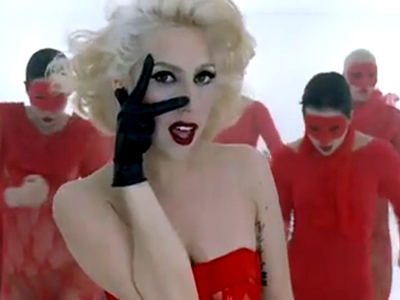
I've mentioned her frequently, great case study of gender representation and the post-feminist position ... but also beyond that of queer representation, an intentional blurring of the gender binary.
On my summer list to return to and develop a new case study...
10 years of Lady Gaga: how she queered mainstream pop forever https://www.theguardian.com/music/2018/apr/10/10-years-of-lady-gaga-how-she-queered-mainstream-pop-forever?CMP=Share_AndroidApp_Blogger
From Madonna to Janelle Monáe: how female sexuality progressed in pop
Spice World: the feminist movie? When girl power hit the the big screen
https://www.theguardian.com/film/filmblog/2017/sep/28/spice-world-the-movie-feminist-bechdel-test?CMP=Share_AndroidApp_Blogger
I don't want these resources to get lost within a very long post, so am re-posting this material. I've considered Gaga in some detail in these terms, and its a key debate you need to address if you're working with a female artist (and arguably even if not!).
The discussion over Cyrus often gets quite frank, mature and sexually explicit treatment. Be aware of this before you click on any of the links below the line.
O'Connor/Cyrus' feminist/post-feminist clash became a major national news story, here on the BBC.
Please note that the video referred to contains scenes intended to disturb and shock.
Gaga has built a fanbase on the back of her publicly supporting many abused outsiders, in this case not the sexual minorities celebrated in Born This Way but female students at US colleges.
The black and white video takes the form of a short film, complete with end titles (and Facebook, Twitter links), tracking the despair and recovery of three victims of abuse, partly reflecting Gaga's own experience aged 19.
I'm not a huge Gaga fan, being old enough to have seen Madonna do much of what her young fans see as novel in Gaga (a great Guardian article this week also looks at how directly Grace Jones has been ripped off by many major pop stars, not just Gaga), but can't see this as anything but a brave move.
An example of Grace Jones' uncredited 'inspiration'
The track is typically overblown (a matter of taste), and I note the 2k YouTube dislikes alongside the 96k likes at the time of writing; this isn't exactly cosy branding.
NB: The video explores sexual themes (especially in the 2nd piece), though without nudity, and does have 1 instance of swearing about 14 mins in.
The Baeble blog is a good place to look for examples of unconventional work for inspiration, ideas or simply to help evidence and justify some of your own whackier ideas as having antecedents in the diverse field if music video.
FKA Twigs has created a long form video to promote an EP, adopting a style that edges more towards art gallery installation than typical small screen fare.
Link below, but note content warning.
Chris Cunningham would be the most obvious influence, though David Lynch equally came to mind for the horror-tinged elements and general oddness. Some more conventional tropes are present and the final piece recalls Janet Jackson, Madonna and that modern-day mini-Madge, Gaga.
Whilst somewhat challenging, the second piece, wherein Twigs becomes a literal doll, plaything, is an intriguing exploration (perhaps plain denunciation?) of the male gaze and its impact.
I'd be curious to see how the BBFC might rate that piece alone; nothing explicit but clearly dark (so arguably disturbing) themes and tone, a borderline 12/15? The one swear word later on would not automatically disbar a 12 by the way.
Noting the content warnings, you can read the article here, or view the video below.
Its clearly been a successful campaign:
Heading towards 3m views (screenshot Dec 6th 2015)
I'll return to this with more links/points later, but for now consider these two seemingly sharply divergent representations of gender and sexuality (Allen has faced considerable flak too) in these two much-discussed vids (part of a contemporary, 2013 triumverate of controversy with Robin Thicke's Blurred Lines [previously blogged on]):
NB: Cyrus' video for Wrecking Ball contains sexual content, while Allen's Hard Out Here contains strong language (and has been accused of racism)
and...
TBC
We could view one as reflective of post-feminist attitudes, the other more traditionally feminist, but its worth noting too such debates take place in many different forms - and with more serious consequences elsewhere. The Femen movement have achieved a high profile in a short space of time, with tactics criticised by others who would label themselves feminists too: appearing topless with slogans scrawled over their bodies. Femen have been active in many countries, but notably Ukraine and Russia - in the latter the travails of Pussy Riot, feminist Russian punks, are well documented in the BBC Storyville film.
More news of Robin Thicke's now notorious (but big-selling) Blurred Lines being banned by over 20 UK universities, it being seen to fall foul of anti-rape/sexual abuse policies.
Thicke has made some wildly divergent statements on the track and accompanying controversy, appearing to welcome and revel in it at times, and declaring himself a proud old-school sexist ... but at other points he's struck a very different note:
Thicke has defended the song, telling one interviewer: "If you listen
to the lyrics, it says 'That man is not your maker' – it's actually a
feminist movement within itself." In October, he told Radio 1 the
song had been misunderstood. "I don't think people got it out here [in
the UK] in those positions of power," he told Newsbeat. "I think the kids get it … I just have to deal with that."
Is Robin Thicke a feminist?!
Perhaps a more interesting question: to what extent should we differentiate between the likes of Wrecking Ball (or Miley Cyrus' on-stage twerking) and Blurred Lines? Is Sinead O'Connor's contention that many young female performers lose authorship of their work, becoming mere puppets for male managers and record executives, a valid one? Is a model sexually posed/objectified in a male artist's video in any regard inferior or superior to a female artist doing likewise in her own video?
A basic, single location video lacking SFX, centred on a powerful female protagonist (the singer), tho' framing focussed on dancers' busts seems dubious. Despite the simplicity, the unusually frequent cutting to the beat, effective use of all the possibilities of the single location, and a strong performance from the singer make this a successful production likely to boost the appeal of the track.
1ST SHOT
Polysemy is initially retained
This is a word I'll use many times in discussing this basically effective vid: simple. A simple example of narrative enigma: we fade up and tilt up to slowly reveal part of a face in CU, with half the frame given over to the mise-en-scene. It takes several shots to fully anchor the club setting, let alone the narrative of a woman setting out to pick a man. The ear-rings, hair styling and heavy make-up are also notable, so too the direct gaze which quickly emerges as a feature of this vid.
A simple video with a linear narrative, using movie signifiers (especially titles). Lyrically centred on women
Filmic titles are used
standing up to men and demanding respect, it can be read as hypocritical or assertive depending on whether or not you buy into the post-feminist position. Key to it, either way, is that the performers costume and appearance ensures that young F viewers could identify with the trio.
1ST SHOT (see screenshot above):
Fade up into a simple ML 3-shot, cut to the 1st beat of the track. The location is a 'grand' hall, but the 3 F performers are fairly plain in terms of clothing (leisure/sports wear) and general appearance - hair tied back rather than scaffolded using enough hairspray to euthanize the ozone layer.
I raise this as a potentially useful concept to include in your consideration of representation issues. This is a feminist protest group that is using nudity to protest at the sexist, misogynistic patriarchy that they believe dominates global culture.
Its pertinent to analysis of music videos and slasher films as each feature near-nudity or nudity frequently, with artists such as Madonna, Rihanna and Lady Gaga clearly trading on their bodies and sexual appeal ... BUT claiming (as post-feminists would argue) to be strong women in control and expressing themselves, rather than victims of the male gaze. The slasher movie is often criticised for its wide use of female nudity, though these feminist campaigners are partly making the point that women have long been encouraged to feel ashamed of their bodies - can a seemingly sexist genre really be reclaimed as a positive expression of female liberation?!
The starkly contrasting ways in which traditional feminists and post-feminists (who believe that equality of the sexes has been achieved, so its outmoded to perceive women as victims of a male-dominated culture, or patriarchal society) read media texts is certainly something for you to consider when analysing your own work as well as existing media texts.
In a chaotic and crumbling former public washhouse in a rundown
district of northern Paris, Inna Shevchenko was explaining how a large
leather punchbag hanging from the rafters might be used by the foot
soldiers of a new generation of feminists. As she prepared to
welcome recruits to the Ukrainian-based feminist group Femen's first
"international training camp", it was clear that the instruction would
not be all ideological. The talk was of "war", "soldiers", "terrorism"
and "enemies". Was it not curious, one French journalist asked, that
Inna and her warriors had adopted the language of combat, traditionally a
male domain, to describe their mission? Was it not also inconsistent, another asked, that the new feminists were using nakedness to rail against female exploitation? In a week that had seen the banning of photographs of a topless Duchess of Cambridge, it was certainly topical. "Ah,
but we have a different idea; we are talking about peaceful war,
peaceful terrorism," Inna said. "We are taking off our clothes so people
can see that we have no weapons except our bodies. It's a powerful way
to fight in a man's world. We live with men's domination and this is the
only way to provoke them, the only way to get attention. "We
don't hide our bodies, we don't hide our faces, we confront our enemies
face to face. We look them in the eyes and we have to be well prepared
physically for that." There was, she explained patiently, no contradiction in going topless or naked to protest
against what they view as the three main evils of a global "patriarchal
society": sexual exploitation, dictatorship and religion. Protesting
naked, as Femen's slogans insist, is liberté, a reappropriation of their own bodies as opposed to pornography or snatched photographs which are exploitation. On a less intellectual level, taking their clothes off ensures a lot of publicity.
The article I'll link below contains strong language and links to semi-nude videos, necessary for the frank discussion of the topic matter but worth being aware of and cautious over.
The article is sparked by the emergence of a female metal band who've gained swift notoriety by performing semi-nude, their costumes leaving little to the imagination. The article never uses the term post-feminist, but the claims of the likes of the Butcher Babies to be feminist would be rejected by traditional feminists, but embraced by post-feminists.
The article, and the reader comments that follow, goes on to discuss more radical acts such as RockBitches, L7, Tribe8, Girlschool (The Runaways, subject of a 2011 film, aren't mentioned but should be), Wendy O'Wiliams and the Plasmatics and many more.
It's a useful article not so much for the specifics on any one act but for exposing and illuminating the contested nature of feminism, and undermining attempts to claim that what makes positive or negative representation is a straightforward process. Its thus one you'd do well to look at when discussing representations within your own work, and how they're perceived.
http://www.guardian.co.uk/music/musicblog/2012/jul/05/butcher-babies-rockbitch-tribe-8
I've briefly posted on AL before; her 80s vids for Eurythmics caused a national outcry when she played with gender expectations by dressing as a man (theory ref: Judith Butler - gender as performativity; also Chomsky's propaganda model as the 'flak' she received was designed to filter such counter-hegemonic thinking out of mainstream media and therefore public consciousness)
From the far reaches of the web, a rather curious take on Lady Gaga...a force for a global conspiracy?!
an extract:
Gaga is not giving birth to a human but to a “new race” within humanity. The symbolism of the video makes it clear that this birth is not natural, but artificially provoked. A twisted immaculate conception. As is the case for most Lady Gaga videos, the theme of mind control is important in the video. It is the process through which the metamorphosis will take place. In Monarch programming terms, we are witnessing the birth of a new persona within the “core personality” of humanity. The birth is happening within the minds of people and is visually represented by creepy facial horns.
Britney indeed bears many classic symptoms of a Monarch programming victim. Further, the video of Hold it Against Me contains many visual clues that hint at Britney’s mental prison.
The next one I came across via Ellie's blog, a detailed look at Bad Romance. The writer sees Gaga as a feminist icon - I'm not so sure, tho' there is definitely a case to make for that interpretation:
The Art of Gaga- Lady Gaga’s Bad Romance Music Video Explained
What is an artist? Musicians have blurred the lines between artist
and being godly, being a role model and having something to say, or
someone who is just famous for the sake of being famous. But, what is an
artist? An artist is someone whom their creations conveys a message. As the
observer, we are the ones to decipher the creation and come to our own
conclusions of what the message is. The message and the medium, however
creative they are, contribute to how interesting the artist is.
Lady Gaga is an artist because she has a lot to say, and a very
colorful way of saying it as well. I would overhear people saying, “she
can’t sing” and I think that’s ridiculous. Of course she can sing, she
has an amazing voice. I respect Lady Gaga as an artist because in my own
interpretation of her music and music videos, I get a message that
wants to change things. She sends messages to express female
frustration, and is changing art to shake things up in the world.
Even though these music videos have been out for a while, I wanted to
write my own interpretation of these music videos. I would talk to my
friends about the importance of “Bad Romance” and “Telephone” and my
friends would say it was garbage. How could I have such a different
opinion about these videos than my friends? Didn’t we see the same music
video? These music videos make the observer think, you have to think
critically of what the message is. Here’s my interpretation:
Lady Gaga- Bad Romance
In
Lady Gaga’s “Bad Romance” video, we are subjected to different
scenarios. We have the the coffin scene, where Gaga is coming out of the
“coffin”, so to speak, as a monster. I think this music video was kind
of the birth of Gaga’s journey as a true artist. She was coming to make a
statement. Also as a self-proclaimed “monster”, she is also telling the
viewer that it’s ok to be different.
We
also have the scene where Gaga is in a sheer, skin colored outfit. She
has pink hair and she is being tied down and being forced to remove her
clothes. In this scene, the big eyes represent innocence to me, and the
people that are taking off her clothes are taking away her innocence,
forcing someone against their will. Also, the fact that they are taking
her clothes away, they are stripping her into a sexual figure.
One
of the biggest scenes to me is when she is in the diamond outfit,
dancing in front of all the suitors while they are bidding on her. She
is a courtesan, a prostitute, being forced against her will to be sexual
for these men. She is reduced to a financial figure for her sex. She
obviously resents the fact at the end of the video. Where you see Gaga
strutting to the bed to the suitor who was the top bidder. She kills
him. An act of revenge against everything that happened to her. Her
being stripped away of her innocence, being reduced for a sexual figure
to be bid on by men.
It’s a very feminist video. There are also images of her as a
“monster” and it’s very obvious that she shape has been altered in the
video. Her spine is protruding out of her skin, and her curves are
accentuated. Has she turned into a sex monster? This video is
retaliating against men. It is showing how women are shown in the media,
and in real life as sexual objects, only there to tantalize and satisfy
men. It has made women into sexual monsters, both wanting to be sexual,
but fighting against the stereotypes men put upon them. And in the end,
Gaga is taking a stand, that she is not going to be ruled by a man,
that she is her own woman.
What about the violence? Is that called for?
There is a lot of violence in movies, men make the violence and now it’s tolerated as a male
thing. It’s also tying into the gender stereotype that only men can get
angry. When men get angry, they get violent. Women are not supposed to
get angry, and hence, not be violent. The violence is a masculine trait.
Gaga takes on this masculine trait to express her revenge, and assert
her independence from men. The lyrics “I want your loving and I want
your revenge” fits in perfectly with the images portrayed. There is
definitely confusion in today’s age of what is a strong woman. Is she
sexual and successful? Is she desired by all men and at the same time
making a lot of money?
Why do people question Lady Gaga’s sex? Is she a man or a woman? She
is taking feminism head on, using masculine traits to assert her
womanhood. She really has picked up where Madonna has left off. Madonna
started a lot of controversies with her sexual videos, questioning
women’s roles in society. She wanted to show women could be successful
and sexual at the same time. Gaga is sending her own message, and using
violence and intense visuals to assert her femininity, and masculinity
at the same time. I think it’s brilliant what Lady Gaga is doing to bring the music video
back. There is so much open to interpretation and people can conclude
their own vision of Gaga’s music videos. What does she say to you? The
fact is that she’s shaping a new era of how women are looked at. Am I
just reading in between the lines too much? I know I’m not because
that’s the point of art, to take away from it your own interpretation of
the art. To question, think and make the art mean something to you.
I will also review the music video “Telephone” because we open up even more cans of worms.
What does Bad Romance mean to you?
A week ago I confused 1,500 sixth-formers by attempting to answer the non-question: "What is art?" The students found a lot of what I said surprising. I hope too many of them didn't ditch their portfolios and start new ones on Lady Gaga, because I rather think their teachers found what I said even more confusing than they did.
...
What is art? Art is anything an artist calls art. An artist is someone who makes or does something she or he thinks of as art.