Deadlines/Brief

Music videos are so 80s/90s, right? They belong with the era when MTV screened wall-to-wall vids instead of 'reality' TV? Try telling that to the millions who bought Gangnam Style; were they really simply loving the music? 1.6bn (and still climbing) have viewed the video on YT, not to mention the many re-makes (school eg, eg2), viral ads + celeb link-ups (even political protest in Seoul) - and it doesn't matter how legit it is, this nightmare for daydream Beliebers is making a lot of money, even from the parodies + dislikes. All this for a simple dance track that wouldn't have sounded out of place in 1990 ... but had a fun vid. This meme itself was soon displaced by the Harlem Shake. Music vids even cause diseases it seems!
This blog explores every aspect of this most postmodern of media formats, including other print-based promo tools used by the industry, its fast-changing nature, + how fans/audiences create/interact. Posts are primarily written with Media students/educators in mind. Please acknowledge the blog author if using any resources from this blog - Mr Dave Burrowes

Showing posts with label blogs. Show all posts

Monday, 27 April 2020

SUMMER 2020 CONVENTIONS TASK

I'll add notes + any documents in this post to make it easier to find than lengthy Teams threads, but the main hub post for your summer work is this post, which has been updated and tweaked across two years of use by A2 students: general conventions research guide post.

Here's a quick reminder of what that post breaks down ... in considerable detail!


...
There is flexibility built into this - you can present this as a number of individual case studies, addressing the yellow-highlighted points, + provide an overall summary through GC10. Or you can merge 1 or more theme. Or you can simply stick to the 10-post structure - so long as your analysis is detailed and spans multiple examples (a minimum of 10 mixed-genre general examples specifically referenced, each at least once in at least one category).

You would be advised to make some use of the very detailed post with a compilation of videos picked for specific useful features, each with further detail/analysis/pointers below, and in many cases additional separate posts too. That's this post, which, like the GCs guide, is included in the top links list for easy reference!

Before you access my notes, see if you think you can think of useful points from the clips in this compilation (the basis of that post):


...

...

Thursday, 14 April 2016

CIE blog improvements summary

Research + Planning improvement points
(1) review/proofread, especially for presentation: well illustrated? hyperlinks? embedded material [not links to this]? no small text? clear sub-headings? embedded material? any 'TBC'? logical post order/date? 
sans spacing!
This is obviously a HORRIBLY presented post!!! Text should never be allowed to dominate on a blog post, especially a long one. It was worse until I at least added some space between points! [see screenshot fragment] Oh ... and tags! No hyperlinks, almost no imagery, nothing embedded (though clear sub-headings, font + colour + size variation...)
(2) is your journey clear? have you reflected on shoots, edits, feedback? posted alternative versions you tried in editing? evidenced FCPX/P'shop (etc) tools you used over time? is there detail on each shoot? DETAIL on each edit (what changes, why; evidence of experimenting: short scenes with different edits [eg FX]; any feedback on this cut; how this cut reflects previous feedback; tools used; planned further changes...); have you used podcasts to anchor the sense of journey? 

Tuesday, 12 April 2016

CIE A2 coursework overview

...
ALSO: See this summary of common issues with coursework.

Lots of docs in this post, so read more link added to prevent slow loading.


...


Wednesday, 6 April 2016

Theory and music video

There are many posts on this (I'm reviewing tags on an ongoing basis to make this easier to find), but just spotted a useful weebly post from another centre, highlighting a range of theories which can usefully be applied: http://a2cw.weebly.com/theory.html.

A great resource for Evaluation work and exam prep
Example: 

Friday, 19 February 2016

USEFUL TECHNOLOGIES: Free infographics tools

A great option for attractively presenting some of your research and analysis; see this post.

USEFUL TECHNOLOGIES: Google calendar

Great way to show your use of technology as well as to help evidence time management (and organisation of cast to boot if you share this with cast!!!), so just the three assessment criteria this can help with then!

Conal (A2 2014-15) produced his own guide, which you can read here. This group embedded their calendar at the bottom of the blog, a smart idea - I clicked back to December 2014 to get the screenshot below:


Wednesday, 13 January 2016

CONVENTIONS A guide to blogging your research

TBC - this is a NEW guide, replacing the previous post/paper guide
In a new series of posts I will break down the major themes/assessment criteria for Research and Planning in particular into four sections:
WHY is this required/important
WHEN should I do this
WHAT posts/content should I create
WITHIN what do I include within these
I will go on to suggest further sub-headings and themes to explore.

WHY
This impacts on several R+P assessment criteria, most directly on 'research into similar products'.

Sunday, 13 September 2015

The Art of the Vodcast

I have previously burbled on at some length about vodcasts - here. This post will be less detailed.

In the context of coursework, podcasts which summarise research are great ... as you can re-edit these for your Evaluation, including comparison with what you actually produced/did.

A vodcast is a podcast with video. It is likely to include your voice, though you can use titles to the same effect.
A SHORTER GUIDE TO GOOD VODCASTING PRACTICE: brief, pithy, well illustrated, creative, expressive, analysis, terminology, concepts, opinion, titles, chapters, top ten, short clips, fair usage copyright law, mix audio levels, limit face time, branded, ident, channel watermark, target audience, tags, YouTube, links lists...

It will be quite brief. About 2 minutes is good; 5 minutes is starting to push it ... and don't go beyond 10 minutes. If you can't fit all your content into that time limit, think about how to split it up into themed chapters.

Brand your vodcasts, as I do. Once you've created a basic 'opening title' sequence for one, you can copy/paste the sequence into any future vodcast and simply edit the titles. I also recently started adding a watermark, in the style of the company or channel logos you see on TV, asserting my brand but also ensuring my work can't be ripped off!
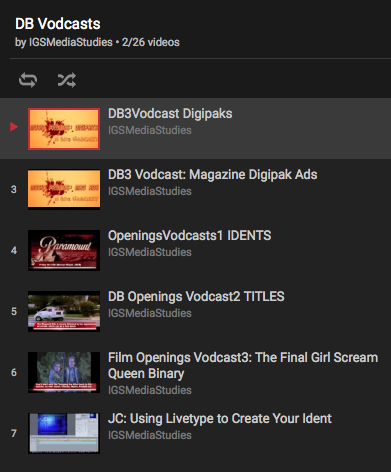
I've created quite a few vodcasts, and will be adding more - a playlist is embedded below

Monday, 31 August 2015

WEBSITES Student examples of band websites

Partial screenshot of the 'group1' 2015 Latymer homepage. Its impressive work by any standard, not just from students

In my previous post, looking at a UK Indie band's website, I started by listing the many advantages of working with a local, Indie act. The following examples of student coursework websites, all from students at Latymer School in London, eschewed major acts, and their websites have a real wow factor. You can find links for their blogs (with videos and digipaks too) here, though I've also copied these in below.

They all used Wix to create their websites, and I'll blog on this separately.
NB: my thanks to chief examiner Pete Fraser for suggesting these as good student examples - you can find Pete blogging on media matters here, and updating his Twitter account here!

What makes these student websites good examples? Well...
  • Most important of all, its not immediately obvious that this is student work, and thats the level you should always aim for! If you have me as a teacher you'll find its a point I'll frequently raise!
  • The website ties together the wider package, in a way that a video/digipak/ad campaign doesn't do quite so naturally.
    Official and bonus video on the video page.
  • The shot variety involved is also likely to be greater than through digipak/ad packages, and you can judge for yourself to what extent separate photography has been commissioned rather than simply rely upon (lowered resolution) screenshots from the cinematography.
    Gallery: not reliant on screenshots; extra photography employed
  • The imagery is carefully constructed with mode of address and audience in mind.
  • Likewise the language used - albeit many Indie acts will use 'strong language' as part of their discourse which these students obviously don't.
    From the Roza website's 'Roza' page [about me equivalent] takes a creative approach
  • The use and intregration of social media is simply superb, making full use of the widgets and apps available to Wix website builders to provide hyperlinked icons, invites to join/follow, and live feeds.
    Its not just a case of dropping in hyperlinked icons, look at how deeply the social media are embedded into the fabric of the site, with icons and #hashtags to the fore, and a colour scheme helping denote various social media. You can also see direct links to wider media, such as XFM and NME, reflecting and targeting a primary and wider audience.

Tuesday, 26 November 2013

Twitter: Adding live feed to your blog

Once you've accessed the code from your own Twitter page its simple...
The process is the same is it is for adding your track as a clickable (for example) DivShare embed: you get the required embed code (in this case from your own Twitter account page), Layout - Add a Gadget - Add HTML/Javascript.
If you need further help with this, use MyBloggerLab.com's guide or ... a Mumsnet guide!!!

Wednesday, 21 November 2012

Misc Post guidelines (use with checklist)

These are arranged in the order they come in on the coursework checklist. Most of these are fairly self-evident, but this should ensure you can always quickly figure out what you should be blogging on

MY CONSUMPTION OF MUSIC VIDS: How do you access music vids (what media techologies do you use)? Has this changed much over the years (do you view more or fewer now than you did, say, 5 years ago?)? Do you download vids, watch on YT, MTV/VH1 etc, specialist chart shows ... Do you view on desktop/laptops, smartphones, tablets; when out and about; with friends or other social settings; do you share vids you like on FB and suchlike? Are you a heavy or light conumer of m.vids? Would you say at the outset of your A2 cwk you are knowledgeable about m.vids?

APPLYING ASSESSMENT CRITERIA TO 2011 VID; APPLYING ASSESSMENT CRITERIA TO 2011 VID: Quote from the assessment criteria (ideally, copy in each one) and discuss what mark you'd give and why (the important bit! needs specific details). An opportunity to embed knowledge of the assessment criteria + a chance to pick up tips on things to do or avoid.

OUR PRODUCTION CO: Whats the name (why?! what are the semiotics?). What's the logo? What sort of work do you think you'd realistically attract, or focus your marketing on (niche genres or all comers?)? Have you researched any existing music vid (etc) producers to get an idea of rates they charge, how they market themselves and their services?

[ARTIST] HISTORY + AUD (and other [ARTIST]-centred posts): You need to show you've thoroughly researched and understood the artist whose material you're using ... and whose image (brand, if you like) you can benefit or damage by your production decisions and outcomes. Knowing who the audience is/was is obviously key, but so researching + being able to reference EXISTING VIDS by the artist, their profile in 201x (ie now), their ONLINE/CULTURAL FOOTPRINT (looking at fanclubs, forums, official sites, FB presence, google results/rankings. YT channel, vid viewings, etc; recent appearances on ads, TV - espec shows like X Factor - mags [think carefully about aud of the mags, can be v, v useful for evidencing primary or secondary aud appeal of the artist - the Girls Aloud eg from 2012 is a great example of this working, with GA appearing in Q and suchlike as well as girls and gossip mags]

[TRACK] LYRICS + BACKSTORY; TIMED LYRIC SHEET; RECORD LABEL; ORIG VID; 2ND LIFE: CYBERSPACE IMPACT: Just as you need to be secure in your knowledge + understanding of the artist so you need to be well aware of what the track is about - regardless of your idea + whether its narrative-based or not. Obviously right from the start you need to break down the track with timings, so when you're discussing how to map footage you're considering onto the track you can do so in an informed and meaningful fashion. You should frequently write notes over copies of this timed sheet and scan in or photograph then upload to blog. The '2nd life' refers to cover versions and other cultural artefacts its inspired online or offline (from Simpsons skits to YT vids - be comprehensive on YT vids). You could explore the term meme here, which I've blogged on with reference to Lady Gaga and Bad Romance before. You are required to evidence having contacted the rights holder with a request to use the track, so you need to identify the record label - as you're probably releasing a compilation album, that might be multiple record labels for the digipak details. Some artists have bought back the rights to their back catalogue, or moved to smaller, Indie labels. How is your track distinct from the original vid; are there any links?

A BRIEF HISTORY OF M.VID: The book Money For Nothing is great for this, and the Wiki is prettty good in this case too. You don't need an essay, just a flavour of key dates and changes, videos over time, especially how technology has changed.

RELATIONSHIP OF [ARTIST] TO GENRE: Is your artist an archetype (early, influential example) of the genre; someone who has copied others, or someone who is a bit of a maverick? Discuss their place within your genre, their level of commercial success, hits/radio play (or lack of), tracks/albums that had major impact etc. Can you find relevant quotes by other genre acts?

CURRENT STATUS OF MUSIC VIDS: This could go in much earlier: are vids still relevant in a mobile, digital world (even MTV shows few vids)? Are they now actually more relevant? Discuss here whether vids continue to have cultural impact and commercial clout (I'd say they do on both counts: we've all heard of Gangnam Style after all).

Wednesday, 12 September 2012

MVid eg notes template

This is a simple table, you could always design your own. The point is to keep a record of your observations - not on scattered pieces of paper or even blog posts, but in one place where you can begin to see patterns, and can refer back speedily months later when you can't quite remember the name of that track where that useful shot example was...

By the time you're finished the A2 coursework you will have examined dozens of MVids (+ d'paks + ads). Again, create a database/spreadsheet if you prefer, but you will need to be able to reference multiple examples of observable format and genre  conventions, tied into points on audience/s and industry/economics as well. It is unlikely you will remember every detail you've blogged on, or made a written note on.

Maintaining a good, detailed record will not only make R+P posts easier but also the Evaluation and the exam (Media Language in YOUR productions is one of the concepts you may be asked to analyse in Q1b).

Its worth printing off a few copies of this simple doc to keep and add notes to at random times: sat in front of the TV, or even in class when not at a computer. You can blog or type up these notes at your convenience then, but will at least know where to find them.

You will immediately need a good list of specific egs for the vodcast on general codes and conventions of the music video format. This is NOT tied to a specific genre at this stage - and remember that any such list of common conventions almost certainly will contain contradictory points, as some things common to some genres will not be seen in others.

Common MVid Cs and Cs

Remember, you can design your own - and before printing off you should really change/delete some of the blurb at the top of the sheet (adding your name is also a good idea!).

Tuesday, 19 June 2012

JUNE-JULY 2012 POSTS YOU NEED

What I'll try to do here is put in below all the posts with guidance on June-July lessons/work that you can use to help with blogging on this. That doesn't mean these are the only posts you could or should use - there are 400 posts on this blog, and the top links-list contains some themed collections of links (you can also try searching the blog on any given topic or artist).

You can access most of these, alongside indicative dates of when these should be completed, in the Word doc below:
June-july every blog post listed

SAMPLE VIDEO ANALYSES
http://musividz.blogspot.com/2012/05/your-posts-on-exemplar-vids.html 

1ST WEEK + SAMPLE VIDS

http://musividz.blogspot.com/2012/06/creating-2012-13-blogs.html
http://musividz.blogspot.com/2012/06/blog-settings-background-colour.html
http://musividz.blogspot.com/2010/10/you-people-are-strange.html - Practice Pitch1
http://musividz.blogspot.com/2012/06/assessment-criteria.html
http://musividz.blogspot.com/2012/05/your-posts-on-exemplar-vids.html
http://musividz.blogspot.com/2011/06/vids-covered-in-lesson-one-mon-june.html
http://musividz.blogspot.com/2012/03/digitisation-from-napster-to-spotify.html
(see also http://musividz.blogspot.com/2011/09/facebook-myspace-youtube-role-of-new.html; http://musividz.blogspot.com/2012/02/posts-on-new-media-q4.html)


MINI-VID
http://musividz.blogspot.com/2012/05/mini-vid-planning.html
http://musividz.blogspot.com/2012/06/learning-from-mini-vid.html
http://musividz.blogspot.com/2012/05/hwk-learning-from-mini-vid.html [duplicate of above post]

CLASS VID
http://musividz.blogspot.com/2012/05/hwk-pitch-for-class-mvid.html
http://musividz.blogspot.com/2012/06/learning-from-classvid.html

MUSIC VIDEO DAY
http://musividz.blogspot.co.uk/2010/06/britney-draft.html#more [The Britney Meme]
http://musividz.blogspot.com/2012/05/hwk-blog-on-mvday-rp.html
http://musividz.blogspot.com/2012/05/hwk-blog-on-mvday-shoot.html
http://musividz.blogspot.com/2012/06/learning-from-mvid-day.html

INITIAL COURSEWORK PITCH
http://musividz.blogspot.com/2010/10/you-people-are-strange.html - Practice Pitch1
http://musividz.blogspot.com/2012/06/ideas-notes-sheet.html
http://musividz.blogspot.com/2011/09/track-selection-some-guidelines.html
http://musividz.blogspot.com/2012/05/hwk-pitch-initial-a2-ideas.html


TEMPLATES
http://musividz.blogspot.com/2012/06/shooting-schedule-template.html
http://musividz.blogspot.com/2012/06/storyboard-template.html
http://musividz.blogspot.com/2012/06/ideas-notes-sheet.html
http://musividz.blogspot.com/2012/06/call-sheets.html

TECHNICAL GUIDES
http://musividz.blogspot.com/2012/06/uploading-hd-footage-exporting.html
http://musividz.blogspot.com/2012/02/eval-answering-through-video.html
http://musividz.blogspot.com/2012/04/changing-blog-settings.html
http://musividz.blogspot.com/2012/04/downloading-youtube-vids.html
http://musividz.blogspot.com/2012/04/tech-tips.html
http://musividz.blogspot.com/2012/03/wordpress-test.html - using PollDaddly for polling/surveys

Monday, 18 June 2012

Learning from MINI-vid

This is the 1st of 3 practical exercises this term, each one getting larger in scale and complexity, culminating in the challenge of Music Video Day on July 12th. There are a lot of things you can be reflecting on having completed the first of these, the mini-vid; illustrate each point with examples from your work on/experience of the mini-vid project, including screenshots and perhaps some vodcast/podcast material. You could collaborate on this as a group if you wish.
Consider questions such as:
  • what makes for a good pitch?
  • what are the key steps involved in R+P?
  • if this had been the actual coursework, what would you have to add/improve (look at the assessment criteria) to get good marks for R+P?
  • what can you say now about the roles of cinematographer, director, producer? is it important to have one person taking responsibility for each of these roles?
  • related to the last point, was your shoot well organised?
  • what can/did go wrong on a shoot, and what steps help you overcome such problems (better still, prevent them from happening in the first place!)? 
  • did shoots take more/less time than you estimated?
  • what difference does working with HD as opposed to mini-DV make?
  • is it necessary to stick to a genre you're familiar with to have a good idea?
  • what issues are raised by working within a group?
  • do you think you could manage a full music video production single-handed?
  • what more have you learned about Final Cut Pro X?
  • how many shots do you now think a good music vid will have for every 30 seconds of screen time?
  • did you shoot each planned shots repeatedly (from different angles)? did you need to shoot more sequences repeatedly to create better shot variation for editing a dynamic video?
  • anything else that occurs to you (eg importance of mise-en-scene and locations; pre-preparing cast with lines + basic direction; having loud portable media player to play track when shooting, dance choreography if relevant etc etc)?
As ever, plentiful relevant screenshots are vital!

Sunday, 17 June 2012

Learning from MVid Day

This is the 3rd of 3 practical exercises this term, larger scale than the previous two. There are a lot of things you can be reflecting on; illustrate each point with examples from your work on/experience of the Class Vid project, including screenshots and perhaps some vodcast/podcast material. You could collaborate on this as a group if you wish.
For this one you should be making clear, detailed points of comparison with the previous two smaller scale exercises (mini-vid and Class Vid).
  • what are the key steps involved in R+P?
  • if this had been the actual coursework, what would you have to add/improve (look at the assessment criteria) to get good marks for R+P?
  • what can you say now about the roles of cinematographer, director, producer? is it important to have one person taking responsibility for each of these roles?
  • related to the last point, was your shoot well organised?
  • what can/did go wrong on a shoot, and what steps help you overcome such problems (better still, prevent them from happening in the first place!)? How did you overcome any problems on the day?
  • how did you find it working to a tight schedule?
  • did shoots take more/less time than you estimated?
  • what difference does working with HD as opposed to mini-DV make?
  • is it necessary to stick to a genre you're familiar with to have a good idea?
  • what issues are raised by working within a group?
  • do you think you could manage a full music video production single-handed?
  • what more have you learned about Final Cut Express?
  • how many shots do you now think a good music vid will have for every 30 seconds of screen time?
  • did you shoot each planned shots repeatedly (from different angles)? did you need to shoot more sequences repeatedly to create better shot variation for editing a dynamic video?
  • anything else that occurs to you (eg importance of mise-en-scene and locations; pre-preparing cast with lines + basic direction; having loud portable media player to play track when shooting, dance choreography if relevant etc etc)?

Learning from ClassVid

This is the 2nd of 3 practical exercises this term, each one getting larger in scale and complexity, culminating in the challenge of Music Video Day on July 12th. There are a lot of things you can be reflecting on having completed the second of these, the Class Vid; illustrate each point with examples from your work on/experience of the Class Vid project, including screenshots and perhaps some vodcast/podcast material. You could collaborate on this as a group if you wish.

  • what makes for a good pitch?
  • what are the key steps involved in R+P?
  • if this had been the actual coursework, what would you have to add/improve (look at the assessment criteria) to get good marks for R+P?
  • what can you say now about the roles of cinematographer, director, producer? is it important to have one person taking responsibility for each of these roles?
  • related to the last point, was your shoot well organised?
  • what can/did go wrong on a shoot, and what steps help you overcome such problems (better still, prevent them from happening in the first place!)? 
  • did shoots take more/less time than you estimated?
  • what difference does working with HD as opposed to mini-DV make?
  • is it necessary to stick to a genre you're familiar with to have a good idea?
  • what issues are raised by working within a group?
  • do you think you could manage a full music video production single-handed?
  • what more have you learned about Final Cut Express?
  • how many shots do you now think a good music vid will have for every 30 seconds of screen time?
  • did you shoot each planned shots repeatedly (from different angles)? did you need to shoot more sequences repeatedly to create better shot variation for editing a dynamic video?
  • anything else that occurs to you (eg importance of mise-en-scene and locations; pre-preparing cast with lines + basic direction; having loud portable media player to play track when shooting, dance choreography if relevant etc etc)?

    Mini-Vid planning

    ...

    ...
    We have 4 lessons this week (Thursday is HE Fayre; Georgia also away Weds), in which you'll be working on the 1st of 3 practical projects this summer term. We start out small and build with the following two.
    The outcome of this 'Mini-Vid' (my term, not recognised terminology) task will be for each group to produce a music video for 30+ seconds of their chosen track ... follow the steps below!
    USE THE STORYBOARD, CALL SHEET etc TEMPLATES YOU CAN DOWNLOAD FROM THE TOP LINKS LIST

    MINI-VID TASK: THE STEPS FOR MONDAY LESSON
    1. You need a pen and your memory stick.
    2. Form into two groups. Once you have ...
    3. ... I'll assign each person one Mac.
    4. Each Mac has a folder called MINI-VID. Open it and you'll find an MP3; you'll see a lyric sheet on the keyboard which you can use for writing on.
    5. You each have TEN minutes from now to individually listen to your track and write down an idea for a music video, using 30+ seconds from the track, which must be possible to shoot in one period and/or overnight (you can book out the HD cams). Each group member must appear in the video, but you can include as many other non-Media students as you wish when filming
    6. The group should now get together at one of their computers and each in turn share their lyrics sheet, play their MP3 on low volume, and pitch/describe their idea/s to the group. You have FIFTEEN mins to do this and then agree which is your favourite track + idea.
    7. Make sure each person copies the MP3 and lyric sheet on their own memory stick
    8. Each group will then pitch their idea to the other group, and we will all discuss this and brainstorm, with any thoughts and suggestions, including existing vids you might want to watch for further inspiration.
    9. If there's any time left each group can start listing (1) locations (2) sequence of filming (3) filming roles [including band/performers, dancers, or narrative/concept characters: it may well be that some people take up multiple roles; you can work with as many non-Media folk as you wish, you just need to act fast to confirm availability + willingness] (4) mise-en-scene requirements including props, costume, make-up. You could also start working on a shotlist. Once you've completed those you can fill in call sheets.
    10. HOMEWORK FOR TUESDAY LESSON: Blog on this process, including your own idea + that chosen by the group. Call the post MINI-VID TASK: INITIAL IDEAS


    MINI-VID TASK: THE STEPS FOR TUESDAY LESSON
    Complete planning + start filming if possible. To complete planning you need to [each of the following need to be blogged on, you could share this work as you go, and share the posts]...
    1. Confirm the idea: you should be able to summarize this in one paragraph (which one of you can shortly blog, and the others can copy this post: MINI-VID: THE CONFIRMED IDEA)
    2. Confirm which section of the track you wish to use (note the timings; you could now setup your Final Cut project and import the MP3)
    3. Write down a list of the characters involved, including each fictional character, performer, dancer etc (remember that each group member must play at least one character; you can work with as many non-Media folk as you wish, you just need to act fast to confirm availability + willingness)
    4. Confirm and list any location/s involved
    5. Confirm the shooting schedule (think about how many different setups are required + how many times you'll want to shoot each sequence from different angles to create shot variation; you need even more shot variation for music vids than film)
    6. Produce a basic storyboard [do not waste time on this: stickmen + words will do fine!!!]
    7. Put all the above together into a call sheet. As you'll be on screen at some point each role will be shared to some extent, but...
    8. Agree on who will be the producer (responsible for ensuring all props/costume are organised, and on the shoot telling the director + cinematographer which shot is next, ticking these off, and making notes on any additional shots taken as coverage)
    9. Agree on who will be the main cinematographer.
    10. Agree on who will be the director (responsible for instructing performers on what to do, whether that be body language, lines for lipsynching, dance choreography, movement, etc)
    Once all thats sorted out, remembering you need to blog on all this, plus the experience of the shoot, editing and final vid for Monday, you can start the shoot! Remember we are away on Thursday at the HE Fayre (and GB on Weds). Ideally you'd have your footage ready to upload and begin editing on Wednesday, otherwise you're leaving yourselves with just Friday to edit and export to hand in.

    Thursday, 14 June 2012

    Track Selection - some guidelines

    [we've had an initial discussion about this; you can find further points below. you're welcome to run any early ideas past me during june/july. this post, mainly intended for building up to the main pitch of coursework proposals, also contains some info about the pitches you'll do in Sept - DB, June 15th 2012]

    There's a lot of points here; make sure you've read through ALL and checked your idea/track choice against these
    You can change your track/idea even after forming a group - you'll have to re-pitch though.
    Look for an additional, separate post on what to think about for the pitch itself.
    • Your track, and the accompanying idea, has to be something that excites you and will sustain your interest over a long, in-depth production.
    • That includes the research you'll have to undertake into the genre and the band.
    • Length is an issue: every 30 secs represents approx 20 shots
    • Its nearly always a better idea to combine TWO of GOODWIN'S 3 types: pure performance will drag, while concept/narrative, essentially short films, probably won't bear repeat viewing which is

    Tuesday, 12 June 2012

    Vids covered in Lesson One (Tues June 12th)

    A NEW ERA? THE MIND BUGGLES...
    DISCUSSION POINTS
    1. WHAT MAKES THIS VID HISTORIC?
    2. TO YOUR EYES IS IT A TYPICAL VID? (WHY?! employ M.Lang as standard...)
    3. DID 'video kill the radio star'? [theory link: Bijker et al 1987] What saved radio (and has four wheels...)? Do YOU listen to digital or web-streamed radio? Radio podcasts?
    4. How relevant/influential is MTV today? Where do YOU access MVids from ... and what terms/concepts from AS study of British cinema does this remind you of? [con.../dig...]


    I'M THRILLED TO BE DOING MUSIC VIDEO!
    MUSIC VID HAS MUCH IN COMMON WITH FILM ... INDEED, SOME MUSIC VIDS ARE SHORT FILMS
    Jackson had been greatly impressed by director John Landis' groundbreaking SFX in the Indie hit An American Werewolf in London, and hired him to transform the pop superstar into a grotesque zombie for this classic vid (a rather tragic irony given his later history).
    Music video is a highly postmodern format, liberally borrowing not just from existing videos, but across all forms of media and wider culture - a video maker has much more creative freedom than a film maker, is less bound by (NOT entirely free from) genre expectations.


    (QUICK DISCUSSION1) ET TU BRUTUS? WHAT'S YOUR UNDERSTANDING OF WHAT THE A2 INVOLVES?

    Friday, 25 May 2012

    HWK: Blog on MVDay shoot

    You should be aiming to take some photos and record some quick behind-the-scenes snippets with your comments and showing YOU in action. This post could be done as a vodcast...

    Blog on:
    1. your specific role and responsibilities, and how you performed in carrying these out
    2. if you had to chip in to help others, discuss this
    3. if you came across problems, discuss these (did you come up with creative solutions?)
    4. how do you think you performed compared to your classmates?
    5. did anyone else particularly impress you/did you learn from how anyone else worked?
    6. did you see others clearly performing the duties of producer, director, choreographer?
    7. what dis/advantages are there to shooting over an entire day as opposed to multiple short shoots spread over several days, possibly weeks apart?
    8. what was the toughest, most challenging aspect of the day?
    9. what was your best contribution to the day?
    10. what was the best contribution by anyone else to the day?
    11. what did you enjoy most about the day?
    12. if you could go back a week, what would you do differently in preparing for the day?
    13. if you could restart the day, what would you do differently?
    14. if you had one tip for a Media student doing this event next year, what would it be?