You need to be really clear on (especially, NOT exclusively!) the fictional protagonist (or Proppian archetype of the hero... Campbell's 'hero' who, reflecting the 'monomyth' - and to a degree Todorov's theory of narrative structure [NEW equilibrium...] will go on a quest, the hero's journey...).
A moodboard will help enormously with this, which can be a mix of objects, people and more. Try this simple exercise...
List 5 films/TV s/he watches; 5 gadgets; 5 items of clothing; 5 places s/he's been to; 5 drinks/foods they like; 5 random further details (eg family, friends, quirks, talents, job...). Now add any 3 images which represent their binary opposite (which might help start developing further characters + flag up things to avoid in costume, body language, mise-en-scene generally...)
NOW can you sum up the character in a couple of sentences?
SUGGESTED POST TITLE
NARRATIVE - visualising the characters [or a sep post for each main character]
FORMAT/PRESENTATION
A Ppt could be a convenient, quick way of doing this (1 heading, 5 images per slide), though adding images into a single Word doc without any accompanying text as an ADDITION would be simply smart - killing two birds with 1 stone, with apologies to our avian friends...
REFLECTING KNOWLEDGE/UNDERSTANDING OF THEORY
Note my brief usage/application of basic narrative theories above - the more you do this, the simpler such concepts will become for you. I only learnt them myself through repeated application!!!
THEORY CHALLENGE
Can you further apply more advanced theory like Hebdige's concept of subcultures, or (and these link together well!) Pierre Bourdieu's notion of cultural capital?
CHARACTER COMPARISON
As you review each set of answers, have a go at expressing the ideas as 1+ existing people/characters (eg the Mr Robot lead with a dash of Graham Norton - a brooding, ultra-talented (area?) individual with a camp side, fondness for pop culture as well as 'high culture'. Can you now create an additional moodboard?
There are many posts on this (I'm reviewing tags on an ongoing basis to make this easier to find), but just spotted a useful weebly post from another centre, highlighting a range of theories which can usefully be applied: http://a2cw.weebly.com/theory.html.
A great resource for Evaluation work and exam prep
Example:
I'm consolidating several past posts here, and including books on media regulation and postmodernism as well as on music video. The more you can apply wider reading and learning on academic concepts and arguments through and in your coursework (especially the Evaluation), the easier you will find the first half of the exam. Section A asks you (Q1a) to apply one or more of a range of concepts to a comparison of your AS/A2 productions, and to discuss theories around one of five key concept areas (MANGeR: Media Language, Audience, Narrative, Genre, Representation) in reference to either your AS or A2 production (it makes sense to go with your A2).
For the second section, there are multiple topics - the one we look at is media regulation. There are suggestions/links for all of these below.
Simply viewing a wide range of music videos, from different eras and genres, is a good idea. If your blog is set up you can add brief notes/bullet points, with screenshots to illustrate, on what you've found most noteworthy. Looking at past examples of student work is useful too - you'll still find lots of good ideas you could use, and could start to consider the do's and don'ts of successful production - what features are excellent, and which less so?
There are many DVD collections, most usefully of directors such as Anton Corbijn, Michel Gondry and Chris Cunningham, that span multiple genres and acts but provide some great featurettes going behind the scenes. You can even catch a show on iPlayer now that features 80s videos and interviews with the stars of those. Simply dipping into one of the many music channels and making brief notes (even if it is literally ONE point that could be useful example, helping you evidence 'Use of Conventions From Existing Texts')
The by now huge archive on this blog is naturally highly recommended! I've more retro-tagging to do, but have managed to go back and tag 100s of posts so far.
There are lots of useful sites/e-zines that feature industry news and highlight new (or classic!) videos: LouderThanWar and Loudwire being two examples that I frequently read myself, using their Facebook updates to do so.
The Guardian remains the best newspaper for media news, features and analysis, and its music section will keep you well updated with industry developments.
BOOKS ON MUSIC VIDEO Book-wise, there are some stand-out options...
Keith Negus' Popular Music in Theory: incredibly useful for both coursework and exam, this gives you a summary of media theories applied to music. Great for the Evaluation, but also blogging about audience; brilliant for both Q1 and Q1b of the exam, and also the pomo essay!
It might be more accurate by now to use web 3.0, but either way Keen is not keen on the workings of the new media, and how the social media giants are transforming wider societal and democratic values as users get accustomed to surrendering privacy, to arguably vacuous virtual interaction, and so forth.
I'll return to Keen; I was sure I had already blogged on him. He's a very useful (highly readable!) sceptic of the wonders of our new interconnected age. Some of his work is available free on Kindle (not sure about other e-readers), and the rest is fairly cheap. I've read most of it, and while it is polemical (he has a point or argument to get across), it was no chore - a genuinely entertaining read!
I'll add more later - but you can always Google 'Andrew Keen'...
Andrew Goodwin writing in ‘Dancing in the Distraction Factory’ (Routledge 1992)
Music videos demonstrate genre characteristics (e.g. stage performance in metal video, dance routine for boy/girl band).
There is a relationship between lyrics and visuals (either illustrative, amplifying, contradicting).
There is a relationship between music and visuals (either illustrative, amplifying, contradicting).
The
demands of the record label will include the need for lots of close ups
of the artist and the artist may develop motifs which recur across
their work (a visual style).
There is frequently reference to
notion of looking (screens within screens, telescopes, etc) and
particularly voyeuristic treatment of the female body.
There is often intertextual reference (to films, tv programmes, other music videos etc).
Michelle Shocked has seen her fanbase all but disappear this week after apparently issuing stridently homophobic remarks onstage (she rejects the claims). The Guardian article below looks at other cases where this happens (they could also have mentioned Megadeth, whose vocalist Dave Mustaine has taken to issuing right-wing statements since becoming 'born again', but then they're not a very Guardian band!).
Useful to consider in the light of theories such as McQuail's uses and gratifications, and the whole idea of fans forming part of their identity through their musical allegiances.
Dixie
Chicks, Morrissey, Donna Summer, Moe Tucker and Eric Clapton all faced a
backlash when they surprised their audiences with unexpected views
Michelle Shocked: and she did. Photograph: Rex Features/Startraks Photo
Guitar-strumming Michelle Shocked used to be beloved by beardy
folk fans and granary lefties. So it came as a curveball at a gig on
Sunday night when she put down her acoustic guitar, pushed aside the
mung beans and delivered an astonishingly anti-gay rant
that claimed "same-sex marriage will be the downfall of civilisation".
And which city did she choose to air these "robust" views? Only gay
capital San Francisco. Yet Shocked isn't the first musician to, well, shock her fans by revealing surprising views ...
Dixie Chicks
Dixie Chicks performing in 2003, when they were monstered by the US
right for gently criticising George Bush. Photograph: Mb Charles/Retna
UK
The mild-mannered Texan country trio were monstered by the US
rightwing and blacklisted by American radio after gently criticising
George Bush in 2003. On tour in London shortly before the invasion of
Iraq, lead vocalist Natalie Maines said:
"Just so you know, we're on the good side with y'all. We don't want
this war, this violence, and we're ashamed the president is from Texas."
Public protests
saw their CDs bulldozed into the ground. The band later posed naked for
the cover of Entertainment Weekly with slogans such as "Traitors",
I've briefly posted on AL before; her 80s vids for Eurythmics caused a national outcry when she played with gender expectations by dressing as a man (theory ref: Judith Butler - gender as performativity; also Chomsky's propaganda model as the 'flak' she received was designed to filter such counter-hegemonic thinking out of mainstream media and therefore public consciousness)
Here's a term that will pop up frequently when analysing vids (and is linked to pomo): DECONSTRUCTIONISM
I'm going to use an eg of a Depeche Mode vid for No Good...
ACT:Depeche Mode TRACK:It's No Good YEAR: 1997 DIRECTOR:Anton Corbijn GENRE: Electro-Pop/Dance MAIN AUDIENCE:M/F 15-34+(both fe/male gaze, 2ndary 35-44 aud from 80s + aspirational tweens + younger teens [10-14])
Gahan ironically dressed as a 70s lounge lizard
META-NARRATIVE + INTERTEXTUALITY
Now, postmodernists argue there is no essential reality, everything is clouded as we view the world through symbols which represent symbols ... There is no such thing as quality; a Kylie Minogue lyric and a Shakespeare are of equal merit - there is simply no objectivity from which we can make such judgements. That poses issues for standard concepts such as genre. Being postmodern, some postmodernists would of course disagree with this depiction, as nothing can be truly defined! As for this song and video, its difficult to pin down what we're referring to when we say thetext:
The music video for "It's No Good" was directed by Anton Corbijn,
depicting the
I mentioned this today; the binary opposition of 'high' and 'popular' culture, and the very many values attached to this notion. Opera, classical music, Shakespeare = high culture; music video, pop, graphic novels = popular culture.
We'll explore the postmodern arguments, and Bourdieu's theory of cultural capital, around this. You could independently read the ideas of the likes of John Storey on this too.
You need to provide a brief factual rundown: artist, track, year, chart position, album it was from, director, genre, audience.
As a starting point, make some notes under the main key concept areas which you'll later be exploring for Q1b of your A2 exam: MANGeR, as in:
Media language (range/type/examples of shots used, and why/to what effect; also includes mise-en-scene)
Audience - thinking about the target audience at the time of release. What elements in the vid signify, or anchor, this target aud? If you're looking at vids from different time periods, have expectations/boundaries changed much? Gender as well as age are key issues here
Narrative - is this a Narr/Concept/Perf (Goodwin's 3 types) vid? What relationship, if any, is there to the vid. Is there a linear or non-linear narrative? Repetition? Jump cuts? This leads into/overlaps with...
Representation - which in turn ties strongly into audience + genre. Positive representations of gender? Stereotypical? Countertypical? How is sexuality handled - a presumption of heterosexuality (you could mention the theory of hegemony here).
Genre - detail the genre signifiers. In YOUR view, what do you expect to see in a vid from this genre? Consider shot types, editing, mise-en-scene/locations, costume and styling, themes, mood, use or not of performance etc
At the heart of the contrast is a judgement over whether these are typical of their type - does either vid have any outstanding, unusual or exceptional features or characteristics? Is it run-of-the-mill and bog standard, simply re-treading the same tired cliches in dozens or even hundreds of similar vids?
Perhaps its actually the archetype from which many later vids took inspiration? Can you see influences from one artist in the video of another?
What do you think influenced the artist (OR director - very often the act has very, very little say in a vid; directors like Michel Gondry, Anton Corbijn and others will control the creative process). Can you say influences from film, TV or other areas of culture?
Consider yourself as audience: as a 17/18 UK, England, Yorkshire male or female, and setting aside your Media student sensibilities to an extent, what is your instinctive, emotional response to it? (You could well consider the Uses and Gratifications theory here).
Do you think the effective audience is different viewed from the perspective of 2011? Does it still work, or it does seem hopelessly outdated? What, if anything, makes it seem old-fashioned? Can you see elements of the zeitgeist represented? (iconic signifiers of a particular point in time) Does the likely reading of the vid change looked at in 2011?
You could ask others what they think - is there a marked difference between male and female responses?
Ultimately, you're teasing out the main features, and folding this into an exploration of expectations (ie, codes and conventions) of music videos.
I dare say some of you will be thinking of female pop artists to use as your track, so a few quick points to start thinking about... Jess has blogged on Rhianna's Umbrellaand Katy Perry's California Gurls(which you may recall was featured in the quiz...) [plus Spice Girls, Village People, Eminem, and Iron Maiden!]
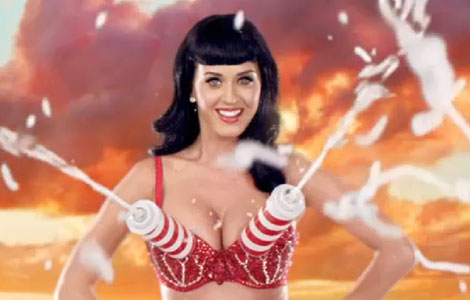
Perry's vid targets the crucial female tween market through cutesiness, but with sassiness and sexuality it also targets older females AND males (gaze). Taken overall, it is part of an environment that teaches us what to expect of women, what the correct or desirable appearance is, and of the differentiated gender roles (with Snoop Dogg, in pimp mode, literally playing with the females here)
Female pop artists typically sell most of their records to young females - tweens and teens, with 'aspirational' a key notion to consider. You can see how the cutesy element of Perry's dirge would appeal to young fans (the whole fantasy element strikes me as lifted from the classic comedy Beetlejuicebtw...). The typically heavy make-up is also something that will influence aspirational t(w)eens, forming part of their cultural socialisation (or, as Judith Butler might put, teaching them how to perform gender).
Every female pop performer also has to consider appealing to a male
audience, and sex is bluntly used by most. This is clearly a delicate
issue to think through if you were working on just such a vid yourselves
- the example of The Vixens from Latymer school is a good one to look at: provocative poses and attire, but nothing explicit.
These A2 Media students went beyond blogging: they also worked up detailed MySpace and other social media sites. They had to consider the balance between provocative poses or 'sassiness' - helping to convince, or achieve verisimilitude - and overt sexuality which wouldn't fit well within a school context (and which would arguably undermine any intended positive element to their representation of gender). Again, don't get trapped into over-emphasizing male gaze: are males their core audience?
Perry appears largely nude, and Rhianna appears fully nude (the body paint, and even that particular pose, not to mention the female sexuality-signifying triangle, have all appeared in vids and classic shots before). Rhianna of course was much-referenced by the PM Cameron when he welcomed a report into how media (especially mags and music vids) prematurely sexualise young females, with the furore over her (and Xtina's) X Factor final appearance. Many of the dance moves are blatantly sexual (ditto the lyrics!). Perry's squirting-bra is a perfect example of how the seemingly cutesy and the simply sordid/sexual collide (as flagged up in the quiz...).
So, yes the male gaze theory would come in here - but its also interesting to consider the male performers. Firstly Snoop, in the Perry vid, is in his famous pimp outfit, hardly a tween-friendly reference, let alone a feminist representation! Perry is his plaything, a very passive role. If you were to compare this to, say, a typical Madonna vid, you'd see a radically different representation of a sexual but strong, in control, woman.
Rhianna, reflecting her Jamaican heritage she might argue, is noted for being scantily clad and sexually provocative dancing. The umbrella arguably takes on a phallic signification, and her whole performance could easily be transplanted to a strip bar! The dancers surrounding Jay Z aren't as near-nude as with a typical male rapper's vid, but their bodies nonetheless are very clearly the key element. The contrast with the male dancers who surround Rhianna towards the end of the vid is clear: they're fully clothed, seemingly 'buff' but they're not required to display their bodies.
The Perry vid is clearly a high-budget effort, tho typifies the absurdity of any claims she ever makes about positively representing women - in my view at least! The Rhianna vid is actually the more interesting. The SFX are expensive - the detail of the water hitting her and bouncing off is impressive.
Rhianna
also deploys sexuality - but is it too simplistic to see this as
playing to the male audience? Does this not also help her appeal to a
heterosexual female audience? To support such an argument we could make
reference to theories such as the Uses and Gratifications model of audience, which looks at the psychological role media texts can play in the lives of audiences, or Maslow's Hierarchy of Needs. You'll need to explore ideas such as these for Q1a+1b of your exam, as well as your Evaluations.
But I also really like the use of her gesture to push away water to create a transition; a wave leads us from LS into CU with water rippling out and revealing the CU.
The variety of shots for even the most mundance passages is also a key factor in making the vid work - look at the sheer number of different shots used from around 1:41 as she dances in a great hall. The cuts are often timed to match the beat too. We also get frequent use of focus pull simultaneous with a judder or shake effect, nicely signifying bass, as if the screen was a speaker, but also with sexual connotations.
The Spice Girls, btw, launched the girl band notion back in '96, when 'girl power' became a buzz word, and they saw their status as role models as important - compare their early vids for a comparative lack of plain sexuality.
So, if YOU were thinking of making a vid along these lines, what would you have to consider?
SEXUALITY: can't be ignored, but clearly there is a line of acceptability - and you should carefully consider how you want to represent gender.
again, The Vixens' vid is a good reference point: heavy make-up, somewhat provocative clothing, movements and gestures, but nothing explicit
confident performers are rather important - you'll see a lot of direct address through looking into the lens, and the next point could be a key factor in casting...
CLOTHING/COSTUME: a key ingredient: a shared look for a group for example? If you're thinking skimpy, where should you draw the line - and are you confident your choices will be agreeable to your cast? Costume changes - most vids feature multiple costume changes, and...
LOCATIONS: Megan/Emmie's 2011 Backstreet Boys vid is a good example of how multiple locations can render a vid a success. For many pop vids tho, you'll be thinking of interiors you can set dress, even something as simple as all white.
DANCERS + CHOREOGRAPHY: Again, Megan/Emmie did a pretty good job getting their boy band to pull off some convincing dance moves (even Jem!). How ambitious do you want to be with the dancing? Do you want opposite sex performers to dance around your singer/s?
I could go on, but I'd like to hear from you - what other issues do you think might be thrown up?
Rhianna... [Umbrella]
The always atrocious Perry... [California Gurls]
Spice Girls (zig-a-zag oh ... very deep stuff!) [Wannabe]
This a great example of a student-produced female pop vid. There's no question that there are sexually provocative elements - some of the dancing, costume choices, heavy make-up and elements of the direct address to camera - BUT nothing explicit, and nothing that would break watershed guidelines. The use of FX, the coherent concept and the all-important choice of set/location, but most of all the fantastic shot variation and tight editing, all make this a very strong vid. The absence of male performers is an interesting choice too.
I still think they missed a trick though: they could have made more of the concept, with the 'voddoo child' line offering opportunities to intercut clips of someone manipulating the comparatively innocent protagonist. Any thoughts?
It later struck me that Xtina would indeed be a good reference point here: controversially explicit BUT many of her lyrics do directly tackle gender issues, as reflected in this battle of the sexes vid...
[Christina Aguilera - Can't Hold Us Down]
Of course, they all learned from the pioneering example of Madonna, once a credible and compelling artist long before she hooked up with the Mockney king and reinvented herself as English rose. Here she is in a narrative vid, with some performance shots intercut, taking on the always controversial topic of teen pregnancy:
[Madonna - Papa Don't Preach]
For the music video Madonna sported a complete image makeover. She changed the heavy jewelry and make-up, and adopted the gamine look, which is notably applied to describe the style and appearance that Shirley MacLaine and Audrey Hepburn used during the 1950s.[38][39] In the video Madonna played a tomboy, dressed in jeans, a black leather jacket, and a slogan T-shirt with the caption "Italians do it Better". The video alternated between tomboy shots and those of a sexier Madonna with a more toned and muscular body, cropped platinum blonde hair, and figure-revealing clothing, consisting of a 1960s-style black bustier top and capri pants.[40] It was directed by James Foley, who worked with Madonna in her video for "Live to Tell",[41] produced by David Naylor and Sharon Oreck, and Michael Ballhaus was in charge of the photography.[42] Actor Alex McArthur was signed to play Madonna's boyfriend and the father of her child in the video. Madonna had spotted McArthur in a small role as a naive youth in the 1985 film Desert Hearts, and she thought he was a natural to play her mechanic boyfriend.[43] "I was out in the garage working on my Harley," said McArthur, "I answered the phone and a voice said, 'Hi, this is Madonna. I would like you to be in my next video.'"[43]
The music video starts with shots of the New York skyline, the Staten Island Ferry, and character close-ups.[44] Madonna plays a teenager, who is seen walking along a lane. Then it shows her thinking about her father, played by Danny Aiello,[40] and how much he loves her. She then sees her boyfriend, played by actor Alex McArthur,[43] coming along. The images are juxtaposed with shots of Madonna dancing and singing in a small, darkened studio. Madonna then moves away from her friends, who warn her from her boyfriend. She and her boyfriend spend a romantic evening together on a barge where they reflect upon their lives after watching an elderly couple. Then Madonna finds out that she is pregnant and after much hesitation tells her father. They have a few days of tension between them. Her father eventually accepts the pregnancy, and the final scene is a reconciliatory embrace between father and daughter.[44]
Georges-Claude Guilbert, author of Madonna As Postmodern Myth, compared her look in the video as a "combination of Marilyn Monroe, Jean Seberg and Kim Novak." He added that it was hard for him to believe that "[Madonna] did not know that she was going to cause a huge controversy with the video.... With such a song and video, she was throwing in America's face the image of a country ravaged by the abortion debate, which is far from being resolved."[45] Lynda Hart, one of the authors of Acting Out: Feminist Performances, felt that the video "alternated between two competing representations of Madonna... Charging coercion, both sides make the video as an invitation to a certain way of life, in the process denying it the stylistic invocation of a rhetoric of self-authorization."[46] At the 1987 MTV Video Music Awards, the "Papa Don't Preach" video won the Best Female Video award, and was nominated for Best Cinematography and Best Overall Performance.[47]
And here she is again with the gloriously ironic track that helped make her a household name, and cemented her appeal to a broad male and female audience: [Madonna - Like a Virgin]
Again, the wiki entry on this is superb:
The music video, directed by Mary Lambert, who worked with Madonna in her video for "Borderline", was shot in Venice, Italy and partly in New York City in July 1984. Madonna was portrayed as a knowing virgin, a figment of the pornographic mind, as she walked through marble rooms, wearing a wedding gown. It alternated with scenes of a slutty-looking Madonna on-board a gondola.[44] She commented, "[Mary] wanted me to be the modern-day, worldly-wise girl that I am. But then we wanted to go back in time and use myself as an actual virgin."[45] The video starts with Madonna boarding on a boat from the Brooklyn Bridge and travels to Venice. As she steps down into the city, she moves like a stripper and undulated sinuously. She wears a black dress and blue pants with a number of Christian symbol embedded jewellery around her neck.[46] She sings the song at full volume as she watches a lion walking between the columns of the Piazza San Marco of Venice and along the statute of Saint Mark.[46] A number of game-playing involving carnival masks, men, lions, werelions are portrayed with allusions to eighteenth-century practices and Saint Mark.[47] Sheila Whiteley, author of Women and popular music: sexuality, identity, and subjectivity, felt that Madonna's image signified a denial of sexual knowledge, but also portrayed her in simulated writhing on a gondola, thus underpinning the simulation of deceit. The intrusion of a male lion, confirmed the underlying bestial discourse of both mythological fairytale and pornographic sex. Whiteley observed that in the video, Madonna's lover wears the lion's mask and while cavorting with him, Madonna sheds the veneer of innocence and shows her propensity for wild animal passions. Having instilled desire, metaphorically she turns her lover into a Beast.[48] Madonna commented about shooting with the lion:
"The lion didn't do anything he was supposed to do, and I ended up leaning against this pillar with his head in my crotch... I thought he was going to take a bite out of me so I lifted the veil I was wearing and had a stare-down with him and he opened his mouth and let out this huge roar. I got so frightened my heart fell in my shoe. When he finally walked away, the director yelled 'Cut' and I had to take a long breather. But I could really relate to the lion. I feel like in a past life I was a lion or a cat or something."[45]
With the video, scholars noted the expression of Venetian vitality in it. Margaret Plant (2002) commented: "With the lion of Saint Mark and the virginal city to the forefront, old sacrosanct Venice was propelled into a pop world of high-energy gyration, and endless circulation."[49] She also noted that Saint Mark was a symbol of a time when sexual crime was punished severely in Venice and acts of rape, homosexuality and fornication incurred the loss of a nose, a hand or sometimes life itself. Madonna appeared to challenge such brutality and stretch the boundaries of tolerance in the video. As the lion-man carried Madonna to the Venetian palace, it symbolized an instance of the Saint taking the simulated Virgin, where Madonna became a symbol for La Serenissima, the Republic itself.[50] Plant also noted that Madonna, in the video, restored the energy and eroticism of Venice, which had its name taken from Venus in familiar elision. As she exchanged her blue top for a black one during the video, Madonna demonstrated her mastery and bravery of the city, which had a reputation of turning out its visitors as victims.[46] Carol Clerk (2002) commented that with the video, "Madonna's days as a cheap and cheerful video star were over. She was moving into serious spectacle."[6]
Perhaps these paragraphs could be the opening paragraphs for an essay about Genre for Question 1B of G325, or perhaps they could be used part way through the essay. In each case, the theorist/ quotation/ theory provides a way of introducing/ developing the argument.
1. As a concept, genre needs to be applied differently to music videos than to, say, film or television programmes. Whereas genres such as sci-fi or thriller are found across different media forms (film/ TV/ radio drama…), it is rare for a music video to use genre in this way (except, perhaps, as an intertextual device, such as REM’s use of the Western in the video for ‘Man on the Moon’). However, an alternative and more useful way of considering genre is to look at musical genres. Andrew Goodwin’s theory that there are conventions that exist within music videos according to musical genre (performances in rock videos; choreography in pop) is a useful way of understanding my video.
2. Nicholas Abercrombie identifies the use of genre for media producers when he writes “Television producers set out to exploit genre conventions”. His argument is that media producers can re-use conventions, creating formulaic and conventional products that are familiar and appeal to the audience, but that are also likely to succeed and therefore are less risky for the producer. In my production of a music video, I looked to exploit conventions of the rock music video, creating a conventional video that, whilst not entirely formulaic, is familiar to the audience and likely to succeed.
3. According to Katie Wales, 'genre is... an intertextual concept', and nowhere is this more appropriate than with music videos. Music videos often revel in intertextuality, using nods to other texts as a way of creating meaning and appeal to the audience. Wales’ statement suggests that genre exists in the relationship between texts rather than in the actual text itself, and in my music video production I used references to other texts and conventions of other music videos to establish familiarity for the audience and to help them understand the meanings and representations of my video.
4. “Genre is not simply given by the culture, rather, it is in a constant process of negotiation and change.” David Buckingham It is important to recognise that genres shift and change over time, and Buckingham’s statement above acknowledges this. I would argue that this is vital to understanding music videos, where in order to appeal to the audience and seem cutting-edge and new, the producers have to reinvent and revise generic conventions to create a fresh and appealing but recognisably packageable product.
5. In creating my music video I was keen to draw upon familiar generic conventions of the rock performance video, but to also try to develop some of these conventions. In this way, my video can be understood in terms of Christian Metz’s theory that genres go through stages: the Experimental/ the Classic/ the Parody/ the Deconstruction. I would argue that my video utilises enough classic conventions of the genre so as to be recognisable as belonging to the rock genre, but that it also seeks to deconstruct and take apart some of these conventions, and in doing so develops the genre.