Please take heed of the warning below - this
post is about videos/music subjected to censorship, so view/read with
caution and not with younger children in sight of your screen.
As I
recently returned to this topic, I've added a few more examples below,
and I'll develop this further when time permits, perhaps into an exam
case study on the mediareg blog (where there are further resources on
this). Use the censorship tag to find more on this blog.
There
are many interesting, highly readable books on the topic - I'll add
details of some I've read as + when time permits, but you can find
examples with a simple 'banned music' search (eg AmazonUK). I'll be reading Southall's book shortly - available on Kindle Unlimited if you're a subscriber.
Brian Southall’s history of the songs, performers, record covers BANNED
by ‘the authorities’ includes the incredible facts behind stories such
as… Roger Daltrey trying to perfect Sonny Boy Williamson’s
stuttering, Cliff Richard banning himself, the airbrushing out of Alice
Cooper’s ‘penis’ on a record cover, and attempts by USA citizens to get
Justin Bieber deported to his native Canada.
Did you know that
Serge Gainsbourg’s ‘Je T’Aime Moi Non Plus’ was the first single banned
from UK’s Top of the Pops and that before that No.1 hit with Jane Birkin
he’d completed an earlier version with Brigitte Bardot? What was
the real reason the Sex Pistols were prevented from topping the singles
chart with ‘God Save The Queen’ in Silver Jubilee week 1977? Why did a falling out between Terence Stamp and The Smiths create a collectors’ item in 1984? Boycotted, banned and the subject of death threats – what exactly was The Dixie Chicks’ crime in 2003?
NB: we also discussed the economic context of the music industry: the concentration of ownership (one of Chomsky's five filters in his propaganda model; filters remove radical counter-hegemonic content before it can shape public discourse or opinion), or consolidation as free market apologists would prefer.
With such scale, the pressure from threats of boycott, often exerted through campaigners targeting advertisers who put ads on some other wing of a conglomerate, can be immense - advertiser power being another of Chomsky (and Herrmann's) propaganda model. Madonna lost a multi-million Pepsi sponsorship when she dared to depict a black Jesus in her Like a Prayer; Time-Warner famously pulled Ice-T's Cop Killer after facing high level political and police pressure, and threats from shareholders. Ice-T now claims the decision was his; he left the record label after the row over this - the Wiki is a short, informative read, but you can find further accounts easily.
When I started out, [Warner] never censored us. Everything we did, we had full control over. But what happened was when the cops moved on Body Count
they issued pressure on the corporate division of Warner Bros., and
that made the music division, they couldn't out-fight 'em in the battle,
so even when you're in a business with somebody who might not wanna
censor you, economically people can put restraints on 'em and cause 'em
to be afraid. I learned that lesson in there, that you're never really
safe as long as you're connected to any big corporation's money. [Wiki]
The big budget music video died with Michael Jackson's reign as king of pop, as the music industry faced up to the disruptive impact of digitization.
Consumer/fan-made videos are widely used by the industry, and lo-fi official videos are not uncommon.
True.
BUT, in some cases this established narrative is being undermined.
Snippet: Film-maker Romain Gavras’s cinematic vision for Jamie xx’s Gosh – which features a cast of 400 people and eschewed CGI and 3D effects – came with one instruction for its viewers: fully immerse yourselves in the apocalyptic experience. “Please watch full-screen with loud speakers or headphones,” Gavras tweeted on its release this month. The video was a moment, rolled out for a track that was originally released more than a year ago. It’s a track that really doesn’t need a music video, let alone a physical copy, designed to look like a knock-off DVD, of a 40-second trailer for said video, which was delivered to journalists days before its official premiere. At a time when the music world is still dealing with illegal downloads and streaming culture, such an ostentatious approach to promoting an old song may appear incongruous. But thanks to the power of a small number of elite artists, music videos are having a renaissance and once more becoming events in themselves, the way they were when Michael Jackson released Thriller or Madonna put out Erotica. Some are cinematic: Beyoncé’s visual album Lemonade, which is set to sweep the board at this year’s MTV Video Music awards; Rihanna’s Sledgehammer, the first video shot using solely Imax cameras. Others, such as David Bowie and Radiohead, have engaged with a new demographic using short, shareable Instagram vignettes. Major artists and their labels are again spending serious money on music videos. However, unlike a few years ago, when the likes of Robin Thicke and Miley Cyrus were going for the shock factor, artists are taking artistic, inventive approaches. When they do try to provoke outrage – as with Kanye West’s Famous or Rihanna’s Bitch Better Have My Money – it’s a step beyond Blurred Lines or Wrecking Ball. How the pop video got weird again.
NB: Some highly controversial videos are listed, including 'explicit' versions; some descriptions also contain some strong language.
See this post for some quick links on useful videos to consider.
As I've discussed analysed a great many videos, the list below is partial. The initial order reflects the order from the video below, with the 1st 20 selected to highlight some of the very, very many themes when considering not just conventions of but also reception for music videos. Most can be found in a playlist too - a great way to expose yourself to a wider range of videos than you are likely to be familiar with!!! More details after the list, but the 20 videos featured in the video (several times more in the playlist) are:
Morbid Angel - Existo Vulgore (2012) [post] You do need to know the conventions ... but there is much more scope to challenge them than with, say, film, as videos like this, and the following Sepultura example, demonstrate. Rammstein and Rage Against the Machine have also produced examples I've blogged on, bringing Snow White and the Beach Boys into the extreme metal genre. Sepultura - Ratamahatta (1996) [animated] [post]
A great example of turning conventions and expectations on their heads, this is an animated video by the Brazilian hardcore thrashers! You should also take from this that inspiration can come from anywhere, including music genres (and other media, as with Morbid Angel) you may not be a fan of! [Wiki]
Here's a bonus, highly countertypical further example: old-school (these guys were well established pioneers when I was still at school!) death metallers Obituary, who for their latest single have turned to Flash-animation and a Scooby-Doo style cartoon ... be advised though: it is, nonetheless, gory. You can read about it and watch it here.
very precise info on how the US industry officially calculates what streams are worth as notional sales
an analysis of the confusion over whether Rihanna's new album is a smash hit or a serious flop
a range of (often hyperlinked) examples of large-scale tie-ins that's seen Samsung especially pay to distribute 1m copies of various albums (including Anti) - not forgetting the controversial U2/Apple case
a new twist on the use of websites as a promotional tool (Rihanna's bewildering recent effort)
her full-on use of social media to tease and trail the album ... then delays ... then confusion between streaming company Tidal (she's a major stakeholder) and record label Universal...
Lengthy feature, packed with highly quotable lines (music video has displaced audio for current generation, Rihanna makes money from social media driven sponsor/endorsement contracts than music sales...)
Blogging, FB and Twitter are social/new media frequently mentioned here as tools used by artists/labels to boost acts'/videos profile and distribution.
Another useful site, heavily used by many artists, from the smallest Indie acts to global names, is Instagram...
On August 9, 2012, English musician Ellie Goulding came out with a new music video for her song "Anything Could Happen".
The video only contained fan submitted Instagram photographs that used
various Instagram filters to represent words or lyrics from the song[63] and over 1200 different photographs were submitted. [Wiki]
VEVO, as a coalition of 2 of the 3 remaining global giants, Universal and Sony, already had a production arm; YouTube acted as the main distributor/exhibitor for its wares (music videos) until now, arguably being of greater importance than MTV and suchlike. Now they've launched their own channels, so are able to boast in-house production, distribution and exhibition.
There's more in the article below, including the assertions that "Part of what we're trying to achieve is that element of
nostalgia but 70% of our audience is under 34."
YouTube has now bought a 10% stake in VEVO.
Rihanna: likely to feature on Vevo TV. Photograph: Stuart Wilson/Getty Images
Thirty-one years after MTV flickered into life to the sound of the Buggles hit Video Killed the Radio Star, the video website Vevo has launched a 24-hour digital music channel in the US and Canada. Vevo,
the site created by record giants Universal Music and Sony, hopes to
recreate MTV's 1980s heyday with the channel, showing a selection of
music videos, live concerts and original programming.
CENSORSHIP: Rihanna's top 5 controversies; [to which we can now add her new album celebrating her domestic abuse? plus her shambolic - omnishambles?! - album launch PR]
Piracy/SOPA - on the Stop Online Piracy Act that brought together a range of campaigners to successfully lobby against this (+ some info on Pirate Bay)
Pro-Palestinian vid controversy - neutral, balanced BBC? Not
according to 2011's Bad News About Israel from the GUMG, nor the article in
this post
I raise this as a potentially useful concept to include in your consideration of representation issues. This is a feminist protest group that is using nudity to protest at the sexist, misogynistic patriarchy that they believe dominates global culture.
Its pertinent to analysis of music videos and slasher films as each feature near-nudity or nudity frequently, with artists such as Madonna, Rihanna and Lady Gaga clearly trading on their bodies and sexual appeal ... BUT claiming (as post-feminists would argue) to be strong women in control and expressing themselves, rather than victims of the male gaze. The slasher movie is often criticised for its wide use of female nudity, though these feminist campaigners are partly making the point that women have long been encouraged to feel ashamed of their bodies - can a seemingly sexist genre really be reclaimed as a positive expression of female liberation?!
The starkly contrasting ways in which traditional feminists and post-feminists (who believe that equality of the sexes has been achieved, so its outmoded to perceive women as victims of a male-dominated culture, or patriarchal society) read media texts is certainly something for you to consider when analysing your own work as well as existing media texts.
In a chaotic and crumbling former public washhouse in a rundown
district of northern Paris, Inna Shevchenko was explaining how a large
leather punchbag hanging from the rafters might be used by the foot
soldiers of a new generation of feminists. As she prepared to
welcome recruits to the Ukrainian-based feminist group Femen's first
"international training camp", it was clear that the instruction would
not be all ideological. The talk was of "war", "soldiers", "terrorism"
and "enemies". Was it not curious, one French journalist asked, that
Inna and her warriors had adopted the language of combat, traditionally a
male domain, to describe their mission? Was it not also inconsistent, another asked, that the new feminists were using nakedness to rail against female exploitation? In a week that had seen the banning of photographs of a topless Duchess of Cambridge, it was certainly topical. "Ah,
but we have a different idea; we are talking about peaceful war,
peaceful terrorism," Inna said. "We are taking off our clothes so people
can see that we have no weapons except our bodies. It's a powerful way
to fight in a man's world. We live with men's domination and this is the
only way to provoke them, the only way to get attention. "We
don't hide our bodies, we don't hide our faces, we confront our enemies
face to face. We look them in the eyes and we have to be well prepared
physically for that." There was, she explained patiently, no contradiction in going topless or naked to protest
against what they view as the three main evils of a global "patriarchal
society": sexual exploitation, dictatorship and religion. Protesting
naked, as Femen's slogans insist, is liberté, a reappropriation of their own bodies as opposed to pornography or snatched photographs which are exploitation. On a less intellectual level, taking their clothes off ensures a lot of publicity.
A nice case study of music vids and censorship campaigns; Rhianna has gone on record as saying a right-wing pressure group that campaigned for her single/vid Man Down to be banned helped it become a hit - see http://www.nme.com/news/rihanna/57235 for more details and the vid being referenced (the web page features strong language)
I dare say some of you will be thinking of female pop artists to use as your track, so a few quick points to start thinking about... Jess has blogged on Rhianna's Umbrellaand Katy Perry's California Gurls(which you may recall was featured in the quiz...) [plus Spice Girls, Village People, Eminem, and Iron Maiden!]
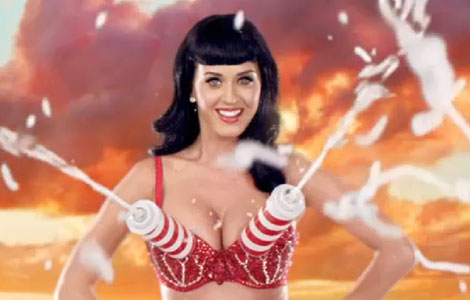
Perry's vid targets the crucial female tween market through cutesiness, but with sassiness and sexuality it also targets older females AND males (gaze). Taken overall, it is part of an environment that teaches us what to expect of women, what the correct or desirable appearance is, and of the differentiated gender roles (with Snoop Dogg, in pimp mode, literally playing with the females here)
Female pop artists typically sell most of their records to young females - tweens and teens, with 'aspirational' a key notion to consider. You can see how the cutesy element of Perry's dirge would appeal to young fans (the whole fantasy element strikes me as lifted from the classic comedy Beetlejuicebtw...). The typically heavy make-up is also something that will influence aspirational t(w)eens, forming part of their cultural socialisation (or, as Judith Butler might put, teaching them how to perform gender).
Every female pop performer also has to consider appealing to a male
audience, and sex is bluntly used by most. This is clearly a delicate
issue to think through if you were working on just such a vid yourselves
- the example of The Vixens from Latymer school is a good one to look at: provocative poses and attire, but nothing explicit.
These A2 Media students went beyond blogging: they also worked up detailed MySpace and other social media sites. They had to consider the balance between provocative poses or 'sassiness' - helping to convince, or achieve verisimilitude - and overt sexuality which wouldn't fit well within a school context (and which would arguably undermine any intended positive element to their representation of gender). Again, don't get trapped into over-emphasizing male gaze: are males their core audience?
Perry appears largely nude, and Rhianna appears fully nude (the body paint, and even that particular pose, not to mention the female sexuality-signifying triangle, have all appeared in vids and classic shots before). Rhianna of course was much-referenced by the PM Cameron when he welcomed a report into how media (especially mags and music vids) prematurely sexualise young females, with the furore over her (and Xtina's) X Factor final appearance. Many of the dance moves are blatantly sexual (ditto the lyrics!). Perry's squirting-bra is a perfect example of how the seemingly cutesy and the simply sordid/sexual collide (as flagged up in the quiz...).
So, yes the male gaze theory would come in here - but its also interesting to consider the male performers. Firstly Snoop, in the Perry vid, is in his famous pimp outfit, hardly a tween-friendly reference, let alone a feminist representation! Perry is his plaything, a very passive role. If you were to compare this to, say, a typical Madonna vid, you'd see a radically different representation of a sexual but strong, in control, woman.
Rhianna, reflecting her Jamaican heritage she might argue, is noted for being scantily clad and sexually provocative dancing. The umbrella arguably takes on a phallic signification, and her whole performance could easily be transplanted to a strip bar! The dancers surrounding Jay Z aren't as near-nude as with a typical male rapper's vid, but their bodies nonetheless are very clearly the key element. The contrast with the male dancers who surround Rhianna towards the end of the vid is clear: they're fully clothed, seemingly 'buff' but they're not required to display their bodies.
The Perry vid is clearly a high-budget effort, tho typifies the absurdity of any claims she ever makes about positively representing women - in my view at least! The Rhianna vid is actually the more interesting. The SFX are expensive - the detail of the water hitting her and bouncing off is impressive.
Rhianna
also deploys sexuality - but is it too simplistic to see this as
playing to the male audience? Does this not also help her appeal to a
heterosexual female audience? To support such an argument we could make
reference to theories such as the Uses and Gratifications model of audience, which looks at the psychological role media texts can play in the lives of audiences, or Maslow's Hierarchy of Needs. You'll need to explore ideas such as these for Q1a+1b of your exam, as well as your Evaluations.
But I also really like the use of her gesture to push away water to create a transition; a wave leads us from LS into CU with water rippling out and revealing the CU.
The variety of shots for even the most mundance passages is also a key factor in making the vid work - look at the sheer number of different shots used from around 1:41 as she dances in a great hall. The cuts are often timed to match the beat too. We also get frequent use of focus pull simultaneous with a judder or shake effect, nicely signifying bass, as if the screen was a speaker, but also with sexual connotations.
The Spice Girls, btw, launched the girl band notion back in '96, when 'girl power' became a buzz word, and they saw their status as role models as important - compare their early vids for a comparative lack of plain sexuality.
So, if YOU were thinking of making a vid along these lines, what would you have to consider?
SEXUALITY: can't be ignored, but clearly there is a line of acceptability - and you should carefully consider how you want to represent gender.
again, The Vixens' vid is a good reference point: heavy make-up, somewhat provocative clothing, movements and gestures, but nothing explicit
confident performers are rather important - you'll see a lot of direct address through looking into the lens, and the next point could be a key factor in casting...
CLOTHING/COSTUME: a key ingredient: a shared look for a group for example? If you're thinking skimpy, where should you draw the line - and are you confident your choices will be agreeable to your cast? Costume changes - most vids feature multiple costume changes, and...
LOCATIONS: Megan/Emmie's 2011 Backstreet Boys vid is a good example of how multiple locations can render a vid a success. For many pop vids tho, you'll be thinking of interiors you can set dress, even something as simple as all white.
DANCERS + CHOREOGRAPHY: Again, Megan/Emmie did a pretty good job getting their boy band to pull off some convincing dance moves (even Jem!). How ambitious do you want to be with the dancing? Do you want opposite sex performers to dance around your singer/s?
I could go on, but I'd like to hear from you - what other issues do you think might be thrown up?
Rhianna... [Umbrella]
The always atrocious Perry... [California Gurls]
Spice Girls (zig-a-zag oh ... very deep stuff!) [Wannabe]
This a great example of a student-produced female pop vid. There's no question that there are sexually provocative elements - some of the dancing, costume choices, heavy make-up and elements of the direct address to camera - BUT nothing explicit, and nothing that would break watershed guidelines. The use of FX, the coherent concept and the all-important choice of set/location, but most of all the fantastic shot variation and tight editing, all make this a very strong vid. The absence of male performers is an interesting choice too.
I still think they missed a trick though: they could have made more of the concept, with the 'voddoo child' line offering opportunities to intercut clips of someone manipulating the comparatively innocent protagonist. Any thoughts?
It later struck me that Xtina would indeed be a good reference point here: controversially explicit BUT many of her lyrics do directly tackle gender issues, as reflected in this battle of the sexes vid...
[Christina Aguilera - Can't Hold Us Down]
Of course, they all learned from the pioneering example of Madonna, once a credible and compelling artist long before she hooked up with the Mockney king and reinvented herself as English rose. Here she is in a narrative vid, with some performance shots intercut, taking on the always controversial topic of teen pregnancy:
[Madonna - Papa Don't Preach]
For the music video Madonna sported a complete image makeover. She changed the heavy jewelry and make-up, and adopted the gamine look, which is notably applied to describe the style and appearance that Shirley MacLaine and Audrey Hepburn used during the 1950s.[38][39] In the video Madonna played a tomboy, dressed in jeans, a black leather jacket, and a slogan T-shirt with the caption "Italians do it Better". The video alternated between tomboy shots and those of a sexier Madonna with a more toned and muscular body, cropped platinum blonde hair, and figure-revealing clothing, consisting of a 1960s-style black bustier top and capri pants.[40] It was directed by James Foley, who worked with Madonna in her video for "Live to Tell",[41] produced by David Naylor and Sharon Oreck, and Michael Ballhaus was in charge of the photography.[42] Actor Alex McArthur was signed to play Madonna's boyfriend and the father of her child in the video. Madonna had spotted McArthur in a small role as a naive youth in the 1985 film Desert Hearts, and she thought he was a natural to play her mechanic boyfriend.[43] "I was out in the garage working on my Harley," said McArthur, "I answered the phone and a voice said, 'Hi, this is Madonna. I would like you to be in my next video.'"[43]
The music video starts with shots of the New York skyline, the Staten Island Ferry, and character close-ups.[44] Madonna plays a teenager, who is seen walking along a lane. Then it shows her thinking about her father, played by Danny Aiello,[40] and how much he loves her. She then sees her boyfriend, played by actor Alex McArthur,[43] coming along. The images are juxtaposed with shots of Madonna dancing and singing in a small, darkened studio. Madonna then moves away from her friends, who warn her from her boyfriend. She and her boyfriend spend a romantic evening together on a barge where they reflect upon their lives after watching an elderly couple. Then Madonna finds out that she is pregnant and after much hesitation tells her father. They have a few days of tension between them. Her father eventually accepts the pregnancy, and the final scene is a reconciliatory embrace between father and daughter.[44]
Georges-Claude Guilbert, author of Madonna As Postmodern Myth, compared her look in the video as a "combination of Marilyn Monroe, Jean Seberg and Kim Novak." He added that it was hard for him to believe that "[Madonna] did not know that she was going to cause a huge controversy with the video.... With such a song and video, she was throwing in America's face the image of a country ravaged by the abortion debate, which is far from being resolved."[45] Lynda Hart, one of the authors of Acting Out: Feminist Performances, felt that the video "alternated between two competing representations of Madonna... Charging coercion, both sides make the video as an invitation to a certain way of life, in the process denying it the stylistic invocation of a rhetoric of self-authorization."[46] At the 1987 MTV Video Music Awards, the "Papa Don't Preach" video won the Best Female Video award, and was nominated for Best Cinematography and Best Overall Performance.[47]
And here she is again with the gloriously ironic track that helped make her a household name, and cemented her appeal to a broad male and female audience: [Madonna - Like a Virgin]
Again, the wiki entry on this is superb:
The music video, directed by Mary Lambert, who worked with Madonna in her video for "Borderline", was shot in Venice, Italy and partly in New York City in July 1984. Madonna was portrayed as a knowing virgin, a figment of the pornographic mind, as she walked through marble rooms, wearing a wedding gown. It alternated with scenes of a slutty-looking Madonna on-board a gondola.[44] She commented, "[Mary] wanted me to be the modern-day, worldly-wise girl that I am. But then we wanted to go back in time and use myself as an actual virgin."[45] The video starts with Madonna boarding on a boat from the Brooklyn Bridge and travels to Venice. As she steps down into the city, she moves like a stripper and undulated sinuously. She wears a black dress and blue pants with a number of Christian symbol embedded jewellery around her neck.[46] She sings the song at full volume as she watches a lion walking between the columns of the Piazza San Marco of Venice and along the statute of Saint Mark.[46] A number of game-playing involving carnival masks, men, lions, werelions are portrayed with allusions to eighteenth-century practices and Saint Mark.[47] Sheila Whiteley, author of Women and popular music: sexuality, identity, and subjectivity, felt that Madonna's image signified a denial of sexual knowledge, but also portrayed her in simulated writhing on a gondola, thus underpinning the simulation of deceit. The intrusion of a male lion, confirmed the underlying bestial discourse of both mythological fairytale and pornographic sex. Whiteley observed that in the video, Madonna's lover wears the lion's mask and while cavorting with him, Madonna sheds the veneer of innocence and shows her propensity for wild animal passions. Having instilled desire, metaphorically she turns her lover into a Beast.[48] Madonna commented about shooting with the lion:
"The lion didn't do anything he was supposed to do, and I ended up leaning against this pillar with his head in my crotch... I thought he was going to take a bite out of me so I lifted the veil I was wearing and had a stare-down with him and he opened his mouth and let out this huge roar. I got so frightened my heart fell in my shoe. When he finally walked away, the director yelled 'Cut' and I had to take a long breather. But I could really relate to the lion. I feel like in a past life I was a lion or a cat or something."[45]
With the video, scholars noted the expression of Venetian vitality in it. Margaret Plant (2002) commented: "With the lion of Saint Mark and the virginal city to the forefront, old sacrosanct Venice was propelled into a pop world of high-energy gyration, and endless circulation."[49] She also noted that Saint Mark was a symbol of a time when sexual crime was punished severely in Venice and acts of rape, homosexuality and fornication incurred the loss of a nose, a hand or sometimes life itself. Madonna appeared to challenge such brutality and stretch the boundaries of tolerance in the video. As the lion-man carried Madonna to the Venetian palace, it symbolized an instance of the Saint taking the simulated Virgin, where Madonna became a symbol for La Serenissima, the Republic itself.[50] Plant also noted that Madonna, in the video, restored the energy and eroticism of Venice, which had its name taken from Venus in familiar elision. As she exchanged her blue top for a black one during the video, Madonna demonstrated her mastery and bravery of the city, which had a reputation of turning out its visitors as victims.[46] Carol Clerk (2002) commented that with the video, "Madonna's days as a cheap and cheerful video star were over. She was moving into serious spectacle."[6]